
Palladium oxide(II) CAS 1314-08-5
High-Purity Palladium(II) Oxide from Aure Chemical – Your Trusted Source
Palladium(II) oxide, PdO, CAS No. 1314-08-5, is a versatile heterogeneous palladium catalyst widely utilized in selective oxidation, hydrogenation, and hydrogenolysis processes across fine chemicals, pharmaceuticals, and advanced materials. Supplied by Aure Chemical as a black to dark brown powder with high palladium content (approximately 87–88% Pd), this stable oxide offers excellent activity, thermal stability, and resistance to common catalyst poisons. It functions directly as an oxidation catalyst or can be reduced in situ to active Pd(0) for hydrogenation applications, making it ideal for converting alcohols to aldehydes/ketones, dehydrogenation of hydrocarbons, reduction of nitro groups, and debenzylation reactions. Its robust performance under diverse conditions and ease of recovery make it a preferred choice in industrial-scale processes. Aure Chemical provides consistent particle size control, high surface area, and secure palladium sourcing to ensure batch reproducibility and optimal catalytic efficiency worldwide.
Basic Information of Palladium(II) Oxide
Aure Chemical supplies Palladium(II) Oxide as a premium Pd(II) heterogeneous catalyst with verified high palladium content and exceptional purity for oxidation and reduction applications.
| CAS No. | 1314-08-5 |
|---|---|
| EC No. | 215-218-8 |
| Chemical Formula | PdO |
| Molecular Weight | 122.42 g/mol |
| Appearance | Black to dark brown powder |
| Odor | Odorless |
| Melting point | Decomposes >800 °C to Pd metal and O₂ |
| Boiling point | Not applicable (decomposes) |
| Density | approx. 8.70 g/cm³ |
| Solubility | Insoluble in water and most organic solvents; soluble in hot concentrated acids (e.g., aqua regia) |
| Nature (hazards) | May cause respiratory irritation, skin and eye irritation, harmful if inhaled as dust, toxic to aquatic life |
| RIDADR | Not regulated (non-hazardous for transport under standard classifications; consult SDS for specific handling) |
| Chemical Structure | 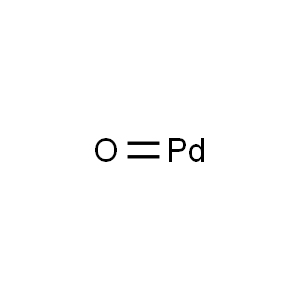 |
Aure Chemical offers customizable options including purity grades, particle size distribution, surface area optimization, and supported forms (e.g., PdO on alumina or carbon) to match your specific oxidation, reduction, or process requirements.
Primary Applications of Palladium(II) Oxide
Palladium(II) Oxide serves as a robust heterogeneous catalyst for selective oxidation and hydrogenation, delivering high performance in demanding chemical transformations. Upon exposure to hydrogen, PdO is readily reduced in situ to catalytically active metallic Pd(0), enabling versatile redox cycling under practical reaction conditions. It is widely associated with applications described in hydrogenation and supported palladium catalysis systems, where controlled activation and recyclability are critical.
Alcohol Oxidation to Aldehydes/Ketones
Catalyzes efficient, selective oxidation of primary and secondary alcohols using molecular oxygen or air, providing clean routes to carbonyl compounds in fine chemicals and pharmaceutical intermediates. The surface redox properties of PdO enable controlled oxidative transformations with minimal overoxidation or byproduct formation.Hydrogenation & Hydrogenolysis
Reduced in situ to active Pd(0) for hydrogenation of alkenes, alkynes, nitro groups, and hydrogenolysis of benzyl protecting groups with excellent activity and selectivity. The heterogeneous nature of PdO allows straightforward catalyst separation and reuse in multi-step industrial processes.Dehydrogenation Reactions
Promotes dehydrogenation of saturated hydrocarbons or alcohols to unsaturated compounds, useful in the production of olefins, aromatics, and specialty monomers. Controlled surface chemistry enables balance between hydrogen removal and substrate stability.CO Oxidation & Emission Control
Employed in catalytic converters and environmental applications for low-temperature oxidation of carbon monoxide and hydrocarbons to reduce emissions. PdO-based systems contribute to effective pollutant removal under variable operating conditions.Fine Chemical & API Synthesis
Supports key oxidation and reduction steps in multistep pharmaceutical manufacturing, offering scalability, easy catalyst separation, and high reproducibility. Its stable oxide form simplifies storage and handling prior to in situ activation.Supported Catalyst Preparation
Acts as a Pd source for generating PdO or reduced Pd on various carriers (alumina, silica, carbon) for tailored heterogeneous catalysis in industrial processes. Impregnation and thermal treatment strategies enable controlled dispersion and particle size distribution.
For a broader understanding of palladium material categories—including salts, oxides, supported catalysts, and organometallic systems across industrial sectors—refer to Palladium Compounds: Applications, Categories & Industrial Uses.
Why Choose Aure Chemical for Your Palladium(II) Oxide Supply?
Partner with Aure Chemical for Palladium(II) Oxide to benefit from superior catalytic performance, customization flexibility, and secure precious metal supply chain management.
High Palladium Content & Activity
Precise analytical control ensures consistent Pd content, optimal particle size, and high active surface area for maximum catalytic efficiency.Custom Formulations & Supports
Tailored purity, morphology, and supported variants (PdO/Al₂O₃, PdO/C) to precisely align with your substrate, reaction conditions, and process scale.Batch-to-Batch Reproducibility
Rigorous testing (ICP, BET, XRD, activity assays) guarantees low variation and predictable performance during scale-up and production.Secure Palladium Supply
Responsible sourcing, strategic inventory, and transparent pricing mitigate market volatility and ensure long-term availability.Technical & Regulatory Support
Expert catalysis team provides activation guidance, poison mitigation strategies, recycling advice, and full documentation (COA, REACH, SDS) for seamless integration.
Hazards Classification
GHS Classification: Skin Irritation (Category 2); Eye Irritation (Category 2A); Specific Target Organ Toxicity, Single Exposure (respiratory) (Category 3); Aquatic Chronic (Category 3)
Hazard Statements: H315: Causes skin irritation; H319: Causes serious eye irritation; H335: May cause respiratory irritation; H413: May cause long lasting harmful effects to aquatic life
UN Number: Not regulated
Hazard Class: Not classified as hazardous for transport
Packing Group: Not applicable


Packaging, Logistics & Compliance Capabilities
Aure Chemical provides flexible packaging solutions, compliant logistics arrangements, and controlled storage practices to support laboratory-scale, pilot-scale, and commercial-scale global supply.
Packaging Options
- 25 kg / 50 kg bags (fiber drum, aluminum bag, HDPE drum)
- 100 kg / 200 kg steel or HDPE drums
- 500 kg / 1000 kg IBC containers
- Bulk liquids in ISO tank containers
- Customized packaging upon request
Transportation Modes
- Sea freight (FCL / LCL)
- Air freight for selected products
- Road and rail transportation
- Dangerous & non-dangerous cargo handling
- Incoterms: EXW, FOB, CFR, CIF, DAP, DDP
Storage & Handling
- Dry, cool, and well-ventilated warehouses
- Segregation by hazard class
- FIFO inventory management
- Temperature-controlled storage if required
- Regular inspection & labeling control
Documentation & Compliance
- Safety Data Sheet (SDS)
- Certificate of Analysis (COA)
- Dangerous Goods Declaration (DGD)
- Packing List & Commercial Invoice
- IMDG / IATA / ADR compliant labeling
For packaging customization or logistics consultation, please contact us.
![Buy [1,1'-Bis(diphenylphosphino)ferrocene]dichloropalladium(II) CAS 72287-26-4 Online from Aure Chemical](/Uploads/pro/11-bis-diphenylphosphino-ferrocene-dichloropalladium-ii-cas-72287-26-4.385.1.jpg "[1,1'-Bis(diphenylphosphino)ferrocene]dichloropalladium(II) CAS 72287-26-4 Supplier")