Synonyms: Ethyl Ethanoate; Acetic Acid Ethyl Ester; Acetate Ester; Ethyl Acetic Ester; Vinegar Naphtha

Aure Chemical is a reliable supplier of Ethyl Acetate in China, delivering consistent quality, stable supply, and professional service to customers worldwide. With extensive experience in chemical sourcing and international distribution, we support customers with flexible supply solutions and comprehensive documentation.

We can provide customized requirements in terms of product purity, packaging specifications, and other aspects.

Please contact us to obtain the latest product information.
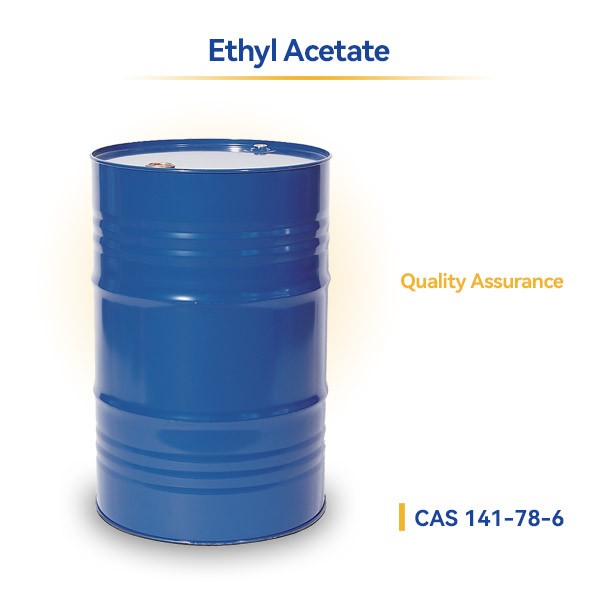
Ethyl acetate, also known as ethyl ethanoate (CAS 141-78-6), is the ethyl ester of acetic acid. It is a fast-evaporating solvent used in industrial coatings, printing inks, adhesives, and chemical processing. Aure Chemical sources industrial ethyl acetate from China and coordinates specification review, batch documentation, and export logistics.
Basic Information of Ethyl Acetate
Ethyl acetate is a clear, colorless liquid with a characteristic fruity odor. The physical properties below are general reference values. The separate quality table gives the reported grade limits and batch results.
CAS No.
141-78-6
EC No.
205-500-4
Molecular Formula
C₄H₈O₂
Condensed Structural Formula
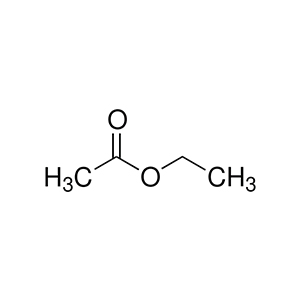
CH₃COOCH₂CH₃
Molar Mass
88.11 g/mol
Appearance
Clear, colorless liquid
Odor
Characteristic fruity odor
Melting Point
Approximately −84 °C
Boiling Point
Approximately 77 °C at atmospheric pressure
Density
See the reported range and result at 20 °C below
Solubility
Limited solubility in water. Miscible with many organic solvents.
Flash Point
Approximately −4 °C (closed cup)
Chemical Structure
Reference Quality Analysis
Superior Grade (≥99.8% Ethyl Acetate by Mass)
The table gives the reported specification and results for one historical batch of industrial ethyl acetate. In addition to assay and appearance, it covers ethanol, water, acidity, residue on evaporation, density, and color. Buyers can use these results to assess which limits to specify for their process or solvent blend.
Test Item
Reported Specification
Reference Result
Appearance
Transparent liquid with no visible impurities
Conforms
Ethyl acetate content, % (m/m)
≥99.8
99.91
Ethanol content, % (m/m)
≤0.05
0.0014
Acidity (as acetic acid), % (m/m)
≤0.004
0.0012
Water content, % (m/m)
≤0.05
0.0120
Residue on evaporation, % (m/m)
≤0.001
0.001
Density at 20 °C, g/cm³
0.897–0.902
0.900
Color, Hazen (Pt–Co)
≤10
5
The historical COA cites the withdrawn standard GB 3728-91. The limits and results above are for preliminary evaluation. Before ordering, confirm the applicable standard and acceptance limits for the offered grade and request a current batch-specific Certificate of Analysis (COA).
Primary Applications of Ethyl Acetate (EtOAc)
Ethyl acetate combines relatively fast evaporation with solvency for compatible resins. The solvent blend and grade depend on the binder, process conditions, and finished-product requirements.
Paints and coatings
Ethyl acetate is used in selected lacquer and coating formulations to dissolve compatible binders such as nitrocellulose and some acrylic resins. In a solvent blend, it can help adjust application viscosity and drying rate.
Printing inks
Flexographic and gravure ink formulators can use ethyl acetate to dissolve compatible binders and tune viscosity and drying to the press speed and substrate.
Adhesives
Ethyl acetate is used as a carrier solvent in selected solvent-based adhesives. Compatibility with the adhesive polymer and the required drying profile determine its role in the solvent blend.
Extraction and chemical processing
Ethyl acetate is used as an organic solvent for selected extraction, synthesis, and purification steps. Solute partitioning, phase separation, and solvent recovery should be assessed for the specific process. Pharmaceutical, food, and cosmetic applications require an appropriate grade and supporting documentation for the intended use.
Ethyl Acetate Sourcing and Export Support
Aure Chemical coordinates with suppliers in China to match the available industrial grade and documentation to the buyer's requirements.
Specification review. Confirm the required assay and limits for water, ethanol, acidity, color, and evaporation residue against the needs of your process.
Quality documentation. Request the applicable product specification, current Safety Data Sheet (SDS), and batch-specific COA for review.
Packaging and export coordination. Confirm packaging, order quantity, lead time, and shipping arrangements for the intended destination.
Safety, Handling and Documentation
The following hazard and transport information is a reference for ethyl acetate. Consult the current SDS for the offered grade and the requirements for the intended transport mode.
GHS reference. Flammable liquid, Category 2 (H225). Eye irritation, Category 2 (H319). Specific target organ toxicity, single exposure, Category 3 (H336).
Hazard statements. Highly flammable liquid and vapor. Causes serious eye irritation. May cause drowsiness or dizziness.
Transport reference. UN 1173 (ETHYL ACETATE), Class 3, Packing Group II.
Handling and storage. Keep containers tightly closed in a well-ventilated area away from ignition sources. Follow the current SDS for ventilation, static control, and protective equipment.