

Chlorophenols in Agrochemical Synthesis | Chemical Intermediates | Aure Chemical
Monochlorophenols may function as substituted aromatic intermediates in selected agrochemical synthesis routes. Their value is structural: each isomer combines a phenolic hydroxyl group, an aromatic chlorine substituent and a fixed 1,2, 1,3 or 1,4 relationship. Agrochemical-intermediate chemistry can depend on maintaining that regiochemistry through subsequent synthesis steps. Industrial selection should therefore begin with the exact CAS number and the required molecular architecture rather than with a generic request for “chlorophenol for pesticide production.”
2-Chlorophenol, 3-Chlorophenol and 4-Chlorophenol share the molecular formula C6H5ClO, but they are different raw materials. Quality and batch consistency can become increasingly important when the same intermediate is produced in repeat commercial campaigns. Changes in positional-isomer profile, residual phenol, moisture or other relevant impurities may influence process reproducibility even when headline assay appears similar. This page focuses on that intermediate-supply problem. It does not discuss field application, pesticide formulation or finished crop-protection products. For chemical identity and a broader comparison, see the overview of 2-, 3- and 4-Chlorophenol isomers.
Why Chlorophenols Are Useful Agrochemical Intermediates
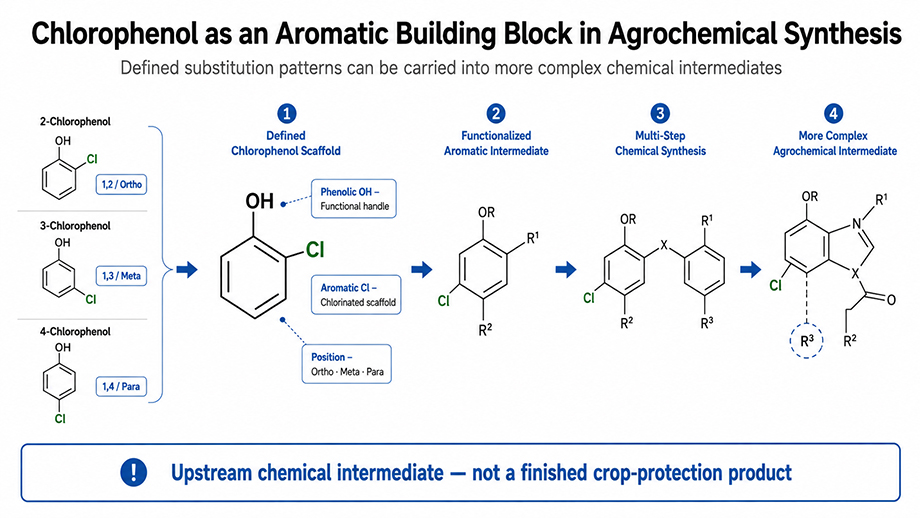
Chlorophenols can provide a pre-defined chlorinated aromatic scaffold together with a phenolic functional group, making them useful upstream building blocks in selected agrochemical synthesis routes. Their value comes from the defined substitution pattern rather than from any claim that every monochlorophenol is widely used in pesticide manufacturing.
An agrochemical-intermediate route that requires both an oxygen functionality and chlorine on an aromatic ring may begin with a monochlorophenol instead of establishing that relationship after additional substituents have been introduced. The phenolic OH can serve as a functional handle for further derivatization, while the chlorine may remain in the downstream scaffold or participate in a separately designed transformation where appropriate. In either case, the ortho, meta or para relationship is already established in the starting material.
This positional certainty can simplify route design by reducing the number of regiochemical decisions that must be solved later in the synthesis. Each downstream intermediate can inherit the 1,2, 1,3 or 1,4 architecture of the selected starting isomer. Impurity discussions can therefore be framed around a defined CAS number and any relevant positional-isomer impurities rather than around an unspecified “chlorophenol” raw material.
This remains an upstream chemical-intermediate role. Chlorophenol itself is not a pesticide, herbicide, insecticide or fungicide merely because it may be used early in a synthesis route that later produces an agrochemical intermediate.
For a deeper discussion of the general transformations available to chlorophenol building blocks, see chlorophenols as building blocks in organic synthesis. This page focuses on route selection, impurity control, batch consistency and industrial sourcing.
Why the Correct Isomer Matters in Agrochemical Route Design
The wrong positional isomer is a different raw material, not a lower-purity version of the correct one. Where the downstream molecular architecture matters, changing the CAS number changes the starting structure rather than merely changing a quality parameter.
| Isomer | Starting Architecture | Route Design Relevance |
|---|---|---|
| 2-Chlorophenol (o-Chlorophenol, CAS 95-57-8) | 1,2 / Ortho | Provides adjacent OH/Cl substitution for routes requiring an ortho aromatic framework |
| 3-Chlorophenol (m-Chlorophenol, CAS 108-43-0) | 1,3 / Meta | Provides a defined meta scaffold for routes requiring a 1,3 relationship |
| 4-Chlorophenol (p-Chlorophenol, CAS 106-48-9) | 1,4 / Para | Provides a para aromatic framework for routes requiring a 1,4 relationship |
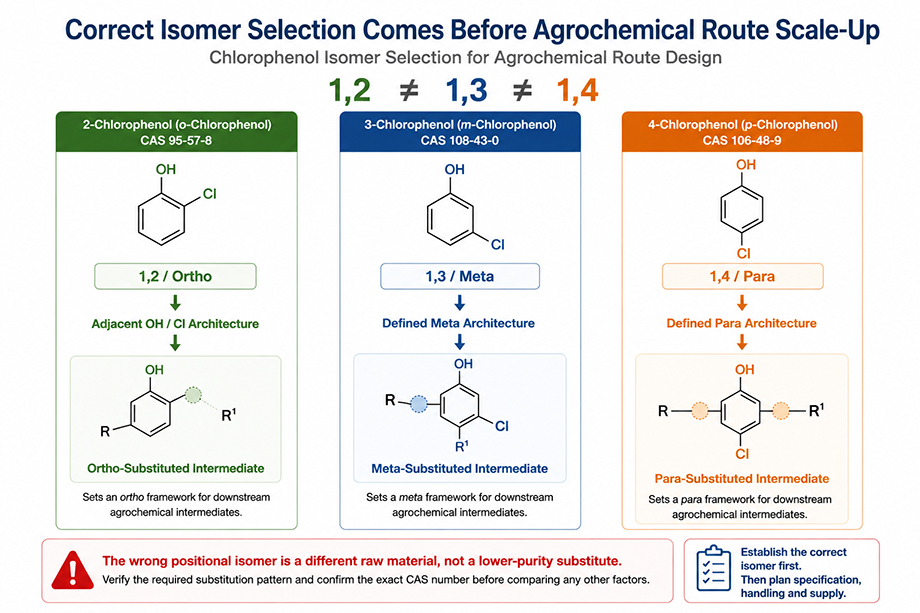
2-Chlorophenol is relevant when the target intermediate requires oxygen and chlorine on adjacent aromatic carbons. 3-Chlorophenol provides a defined 1,3 relationship that cannot be reproduced simply by substituting the ortho or para isomer. 4-Chlorophenol provides a 1,4 framework. These statements describe molecular architecture; they do not rank generic reactivity and do not imply that one isomer is inherently better for herbicide, pesticide or other crop-protection synthesis.
If the target substitution pattern is known, the exact CAS number should be established before comparing packaging, physical form or price. If the remaining questions concern specification, impurity limits, physical handling or procurement, see how to choose between 2-, 3- and 4-Chlorophenol.
Why Impurity Profile Matters in Multi-Step Agrochemical Synthesis
Assay is an important baseline quality parameter, but it is not a complete description of process suitability. Assay indicates how much of the named chlorophenol isomer is present. It does not necessarily identify the remaining components, and those components may matter to a multi-step synthesis route.
Positional-isomer impurities are especially important when regiochemistry is part of the customer’s controlled intermediate specification. An unwanted monochlorophenol isomer may undergo similar O-functionalization or other downstream transformations and generate a corresponding regioisomeric impurity. Depending on the route, this may increase impurity burden, purification requirements or analytical complexity, or influence compliance with a downstream intermediate specification.
The unwanted isomer will not necessarily survive every synthesis step. However, if a structurally related regioisomeric impurity persists, controlling it at the starting-material stage may be more practical than relying on downstream removal after additional molecular complexity has been introduced.
Residual phenol lacks the chlorine substituent present in monochlorophenols. Depending on the route, it may participate in parallel chemistry, generate non-chlorinated derivatives, consume reagent or increase purification requirements. There is no universal acceptable limit; where residual phenol is important to the process, that requirement should be included in the specification discussion.
Moisture may matter in water-sensitive processing, certain reagent systems or oxygen-functionalization steps. It is not universally critical for every agrochemical-intermediate route. Where water can influence the intended reaction or process, moisture should be treated as a defined material attribute rather than inferred from appearance.
Related organic impurities and unidentified analytical peaks may also become relevant as a project moves into repeat production. The important question is not only the total assay but also which impurities are present, whether the analytical method resolves them adequately and whether they matter to the qualified process.
Two lots with similar assay may therefore have different process suitability if their positional-isomer profiles or other critical impurity characteristics differ materially.
Batch Consistency in Repetitive Agrochemical Intermediate Production
A raw material that performs satisfactorily during initial evaluation should still be controlled against defined critical attributes during repeat commercial supply. Commercial agrochemical-intermediate production may involve repeat batches or campaign-based production, making lot-to-lot consistency an important process consideration.
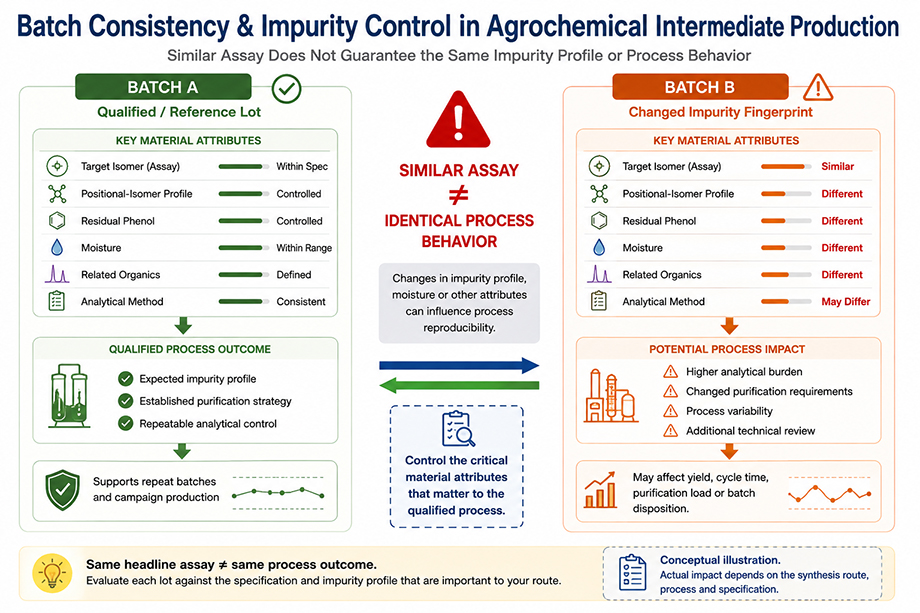
Parameters that may matter during repeat production include assay, positional-isomer profile, residual phenol, moisture, related organic impurities, appearance and the analytical method used to report those values. The process does not necessarily require every future lot to be analytically identical to the original evaluation sample. Instead, critical attributes should remain within the limits established for the qualified process.
Changes in analytical methodology can also influence how impurities are detected, separated and reported. Method consistency — or appropriate comparison between analytical methods — may therefore matter where a process depends on defined positional-isomer or impurity limits.
Appearance may also vary with storage temperature, particularly for low-melting materials, without that physical change itself demonstrating a chemical-quality problem. The specification and receiving procedure should distinguish relevant chemical attributes from expected physical-state behavior.
The practical objective is for critical material attributes used by the process to remain within an agreed window, supported by analytical methods capable of measuring them. This is the difference between a successful evaluation lot and a raw material that is suitable for repeat commercial supply.
Why Raw-Material Consistency Can Affect Downstream Process Efficiency
Raw-material variability may influence reaction performance, impurity formation, purification requirements, analytical workload and overall process reproducibility. The magnitude and direction of those effects depend on the individual synthesis route and should not be reduced to a universal yield or cost penalty.
For example, an unwanted positional isomer that is transformed alongside the target compound may increase purification requirements or analytical workload later in the process. Residual phenol may generate a parallel non-chlorinated impurity family, while unexpected moisture may affect a water-sensitive reaction system. These outcomes are route-specific rather than automatic.
The commercial-scale objective is to keep incoming raw material sufficiently consistent with the qualified impurity profile and critical material attributes so that the established process and quality-control strategy remain appropriate. This is a process reproducibility issue as well as a purchasing consideration.
Analytical and Quality Information Buyers May Review
The analytical method should adequately separate and quantify the components that are important to the customer’s process. The technique name itself matters less than fitness for purpose. GC, HPLC or another suitable method may be used depending on the specification and components being controlled.
| Quality / Analytical Item | Why It May Matter |
|---|---|
| Assay | Confirms the level of the target chlorophenol isomer |
| Positional-isomer profile | Supports control of unwanted ortho, meta or para isomers |
| Residual phenol | Tracks a potential non-chlorinated precursor impurity |
| Moisture | May be relevant in water-sensitive routes |
| Related organic impurities | Helps define the overall impurity fingerprint |
| Analytical method | Determines whether critical components are adequately resolved and quantified |
| Batch identification | Supports lot traceability |
| Appearance | Provides a supporting receiving observation |
A COA that lists only a single “purity” value may not provide enough information to determine whether another monochlorophenol positional isomer is included in the remainder. Where regiochemical purity matters, buyers should understand whether the analytical method can distinguish the relevant isomers and quantify the impurities critical to the process.
Appearance remains a useful receiving observation, but it does not replace analytical information. Changes in color or physical form may relate to storage and handling conditions rather than necessarily indicating failure of the agreed chemical specification.
Current specifications and available analytical detail should be confirmed for the specific isomer and project. Literature values and generic catalog grades should not be treated as customer-qualified specifications.
From Laboratory Evaluation to Commercial Agrochemical Production
Sample approval is not the same as commercial lot control. A typical evaluation pathway may include identifying the exact isomer and CAS number, defining critical quality requirements, reviewing the specification and a representative or current COA, evaluating a sample where appropriate, confirming analytical alignment, establishing commercial acceptance criteria and then moving into repeat supply.
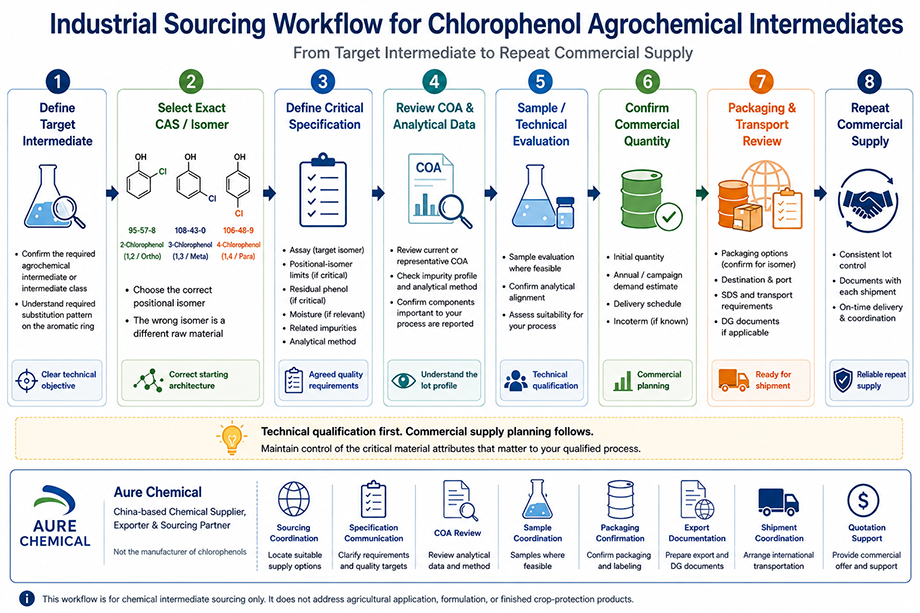
At larger scale, handling, batch consistency, packaging and delivery planning may become more important than they were during laboratory evaluation. Physical-form differences should be addressed after the correct molecular isomer has been selected. They should not be used as a reason to substitute one CAS number for another.
Packaging, Transport and Storage Considerations
Packaging and transport should be reviewed after the correct chlorophenol isomer has been established. Appropriate options depend on physical form, quantity, destination, applicable transport requirements and the buyer’s receiving and handling system.
The three monochlorophenols do not behave identically under ordinary handling conditions. 2-Chlorophenol is typically handled as a liquid near common ambient temperatures. 4-Chlorophenol is normally handled as a solid. 3-Chlorophenol has a melting range close to common warehouse temperatures and may be present as a solid, partially melted material or liquid depending on storage conditions.
These differences may influence sampling, transfer and receiving procedures, but they are process characteristics rather than indicators of chemical quality. For a detailed physical-form and handling comparison, see how to choose between 2-, 3- and 4-Chlorophenol.
Dangerous-goods classification and applicable transport requirements should be confirmed for the specific product or isomer and mode of transport using the current SDS and relevant shipping documentation. Classification or logistics requirements should not be copied from one isomer, shipment or destination to another without verification.
Storage and receiving systems should also be considered. A facility designed for solid charging may require different procedures from one designed for liquid transfer. Current packaging and shipment options should be confirmed for the specific isomer, quantity and destination.
Documentation for Agrochemical Intermediate Sourcing
Documentation should match the product, destination and transaction requirements. Availability depends on the specific supply project, and not every document listed below is automatically included with every shipment.
| Document / Information | Typical Purpose |
|---|---|
| Product specification | Defines required or agreed quality parameters |
| Representative / current COA | Provides analytical results for technical review |
| SDS | Provides safety, handling and transport information |
| TDS if available | Provides additional technical product information |
| Analytical information | Supports impurity and isomer-profile evaluation |
| Packaging details | Supports receiving, storage and logistics planning |
| Batch identification | Supports traceability |
| Commercial invoice / packing list | Supports international shipment documentation |
| DG documents where applicable | Supports transport compliance where required |
| Certificate of Origin where required | May support customs or trade requirements |
Specification, representative or current COA, SDS and relevant analytical information are common starting points for technical review. Commercial, customs and dangerous-goods documents should then be confirmed according to the shipment, destination and receiving requirements.
Evaluating a Chlorophenol Supplier for Agrochemical Projects
Price should normally be compared after technical suitability has been established. Industrial buyers may evaluate whether a chlorophenol supplier understands the exact CAS number, can discuss relevant impurity requirements, provides usable analytical documentation, communicates clearly about batch consistency and packaging, and can coordinate export and shipment requirements.
Supplier evaluation may therefore include:
Accurate identification of the required chlorophenol isomer and CAS number
Understanding of the required specification and critical impurity parameters
Availability of representative or current COA information
Clarity regarding the analytical method where positional-isomer control matters
Batch consistency for repeat commercial supply
Sample coordination where feasible
Packaging confirmation
Export and transport documentation capability
Communication regarding commercial quantities and delivery planning
Aure Chemical is a China-based chemical supplier, exporter and sourcing partner. It is not the manufacturer of the chlorophenols discussed on this page and is not an agrochemical or pesticide producer. For a defined chlorophenol inquiry, Aure Chemical can support sourcing coordination, specification communication, COA review, sample coordination where feasible, packaging confirmation, export documentation, commercial quotation and international shipment coordination.
Current specifications, packaging options and commercial availability should be confirmed for the specific isomer, quantity and destination.
What Agrochemical Buyers Should Include in an RFQ
A request that only states “chlorophenol for pesticide production” does not identify which of the three positional isomers is required or what quality profile the process needs. A more complete RFQ helps the supplier evaluate the correct material and commercial supply solution.
Exact chlorophenol isomer and CAS number
Required assay or specification
Positional-isomer limits if critical
Residual phenol requirement if critical
Moisture requirement if relevant
Intended intermediate or general application class
Whether a sample is requested for evaluation
Initial quantity and estimated annual or campaign requirement
Destination country or port
Preferred Incoterm if known
Packaging requirement or receiving-site constraints
Required technical, commercial and transport documentation
Delivery schedule if known
If some parameters are still under development, providing the exact CAS number, quantity, destination and general application is a useful starting point. Impurity limits and analytical requirements can then be refined after available specifications and COA data are reviewed. A crop-protection end-use description should not replace the exact structural requirement.
Frequently Asked Questions About Chlorophenol Agrochemical Intermediates
Why are chlorophenols used as agrochemical intermediates?
Chlorophenols combine a phenolic oxygen functionality, an aromatic chlorine substituent and a defined substitution pattern on one benzene ring. This combination can make them useful upstream aromatic building blocks in selected multi-step agrochemical-intermediate synthesis routes.
Are chlorophenols themselves pesticides?
No. A monochlorophenol is not a pesticide, herbicide, insecticide or fungicide merely because it may be used upstream in an agrochemical synthesis route. This page concerns industrial chemical-intermediate supply rather than agricultural application or pesticide formulation.
Are 2-, 3- and 4-Chlorophenol interchangeable?
No, where downstream molecular architecture matters. The three compounds are different positional isomers and therefore different starting structures. A high assay on the wrong CAS number cannot provide the required 1,2, 1,3 or 1,4 substitution relationship.
Which chlorophenol isomer should be selected?
Selection depends on the downstream molecular structure required by the synthesis route. 2-Chlorophenol provides a 1,2 / ortho relationship, 3-Chlorophenol provides a 1,3 / meta scaffold and 4-Chlorophenol provides a 1,4 / para framework. After the architecture is fixed, see how to choose between 2-, 3- and 4-Chlorophenol for specification, physical-form and procurement considerations.
Why do positional-isomer impurities matter?
An unwanted monochlorophenol isomer may undergo similar downstream chemistry and generate a corresponding regioisomeric impurity. Depending on the route, that impurity may increase purification requirements or analytical complexity and may affect downstream intermediate specifications.
Is high purity alone enough?
No. Assay indicates the amount of the named compound but does not necessarily identify the remaining impurities. Another positional isomer, residual phenol, moisture or other related organic impurities may have different process implications. Suitability therefore depends on the complete specification and impurity profile rather than on a universal purity number.
Why is batch consistency important for commercial agrochemical-intermediate production?
Repeat or campaign-based production depends on incoming raw material remaining sufficiently consistent with the attributes established during qualification. Material changes in positional-isomer profile, residual phenol, moisture or other critical impurities may affect purification requirements, analytical workload or overall process reproducibility even when assay remains similar.
What documents should buyers request?
Common starting documents include the product specification, a representative or current COA, the SDS and relevant analytical information. Depending on the product, destination and transaction, additional documentation may include packaging information, commercial invoice, packing list, dangerous-goods documents and Certificate of Origin.
Can Aure Chemical provide samples or commercial quantities?
Sample coordination may be discussed where feasible depending on the product and project requirements. Commercial quantity, packaging and shipment options should be confirmed for the specific chlorophenol isomer, specification and destination after the technical requirement has been defined.
Discuss Your Chlorophenol Requirement
If your project uses a chlorophenol as a starting material or aromatic intermediate in agrochemical-intermediate synthesis, provide the exact CAS number, required specification, critical impurity limits, quantity, general application, destination, packaging requirements and documentation needs. These details allow a more technically relevant supply evaluation than a generic catalog inquiry.
Aure Chemical can help coordinate suitable sourcing, technical specification discussion, representative or current COA review, sample coordination where feasible, commercial quotation, documentation and export shipment as a China-based chemical supplier, exporter and sourcing partner.