

Chlorophenols in Organic Synthesis & Specialty Chemical Manufacturing | Aure Chemical
Chlorophenols in organic synthesis are compact aromatic intermediates rather than finished products. Each monochlorophenol combines a phenolic hydroxyl group, an aromatic chlorine substituent and a fixed substitution pattern on one benzene ring. The OH group can be converted into ether or other oxygen-functionalized derivatives, the chlorinated ring can remain in the target or be used later, and the 2-, 3- or 4-position already encodes downstream regiochemistry.
The three commercial monochlorophenol isomers share the formula C6H5ClO, but they are not interchangeable starting materials. Ortho, meta and para substitution create different molecular architectures and different steric environments around the phenolic oxygen. Selecting the correct isomer is therefore a synthesis-design decision before it is a purchasing decision. This page explains how those features support specialty chemical manufacturing and what chemists should specify when sourcing a chlorophenol building block.
Why Chlorophenols Are Useful Aromatic Building Blocks
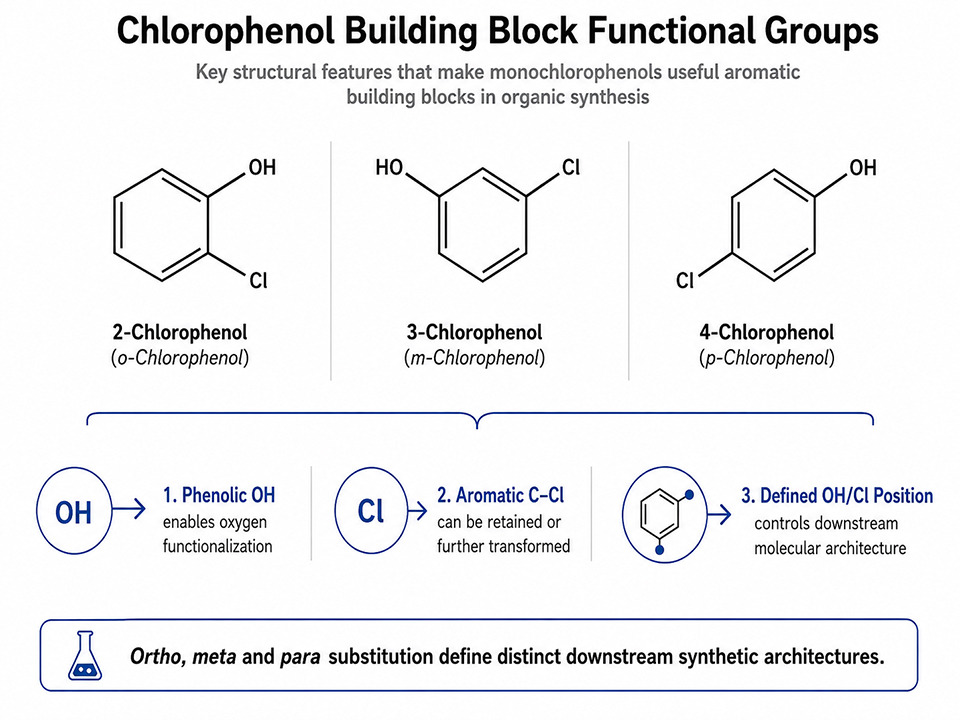
Chlorophenols combine a reactive phenolic hydroxyl group, a chlorinated aromatic framework and a defined substitution pattern, making them useful starting points for more complex aromatic intermediates. Their value is not that every reaction is equally available on every isomer. It is that one small molecule already contains three design elements a chemist would otherwise have to install separately.
Phenolic Hydroxyl Group
The phenolic OH is the most immediately usable handle. Under suitable reaction conditions it can be converted into aromatic ethers, esters or other oxygen-containing derivatives, changing polarity and downstream reactivity without moving the chlorine atom. In many routes the phenol is alkylated or otherwise protected first; in others the free phenol is required in the finished intermediate. Because the oxygen stays on a defined ring position, the resulting chlorophenol ether or ester still carries the original ortho, meta or para relationship.
Aromatic Chlorine Substituent
The aromatic chlorine can play two different roles. In many specialty intermediates it is retained as part of a chlorinated aromatic scaffold. In other designed routes it may participate in further substitution or coupling chemistry. That second role must be treated carefully. An aryl chloride does not behave like an ordinary alkyl chloride. Reactivity of the aromatic C–Cl bond depends on substitution pattern, additional activating groups, the intended mechanism, the catalyst system and the rest of the molecule. Simple monochlorophenols are not strongly activated toward direct nucleophilic displacement of the aromatic chlorine, and the free phenolic OH can interfere with some metal-catalyzed processes. Feasibility should therefore be judged from the planned reaction system, not from the presence of chlorine alone.
Defined Positional Substitution
The third advantage is regiochemical certainty. A chemist who starts with 2-chlorophenol already has a 1,2-relationship between OH and Cl. 3-Chlorophenol supplies a 1,3-pattern. 4-Chlorophenol supplies a 1,4-pattern. Installing that relationship later, after other substituents are present, may be more difficult and can create additional regioisomer-control challenges compared with choosing the required isomer at the outset. The aromatic ring remains available for further functionalization, but the existing OH and Cl groups already influence both electronic directing effects and steric access. That is why monochlorophenols function as building blocks: they define a substitution pattern early, then allow controlled elaboration of oxygen chemistry, ring chemistry or both.
| Structural Feature | Synthetic Role | Important Limitation |
|---|---|---|
| Phenolic OH | Enables ether formation, ester formation and other oxygen-functionalized derivatives; can be protected or left free depending on the route | The free phenol can participate in competing reactions or interfere with some catalyst systems and may require functional-group management |
| Aromatic C–Cl | Can remain in the downstream scaffold or, under suitable activation and reaction design, participate in substitution or coupling chemistry | Aryl chlorides are not equivalent to alkyl chlorides; simple monochlorophenols do not automatically undergo easy displacement |
| Defined positional substitution | Locks an ortho, meta or para relationship into the starting material and into most downstream derivatives | The three isomers are not interchangeable; the wrong isomer creates the wrong molecular architecture |
| Aromatic ring | Provides a platform for further ring functionalization when compatible with existing substituents and the intended mechanism | The phenolic OH strongly influences electronic directing effects, so additional substitution must be planned around the existing substitution pattern |
Functionalization Pathways of Chlorophenols in Organic Synthesis
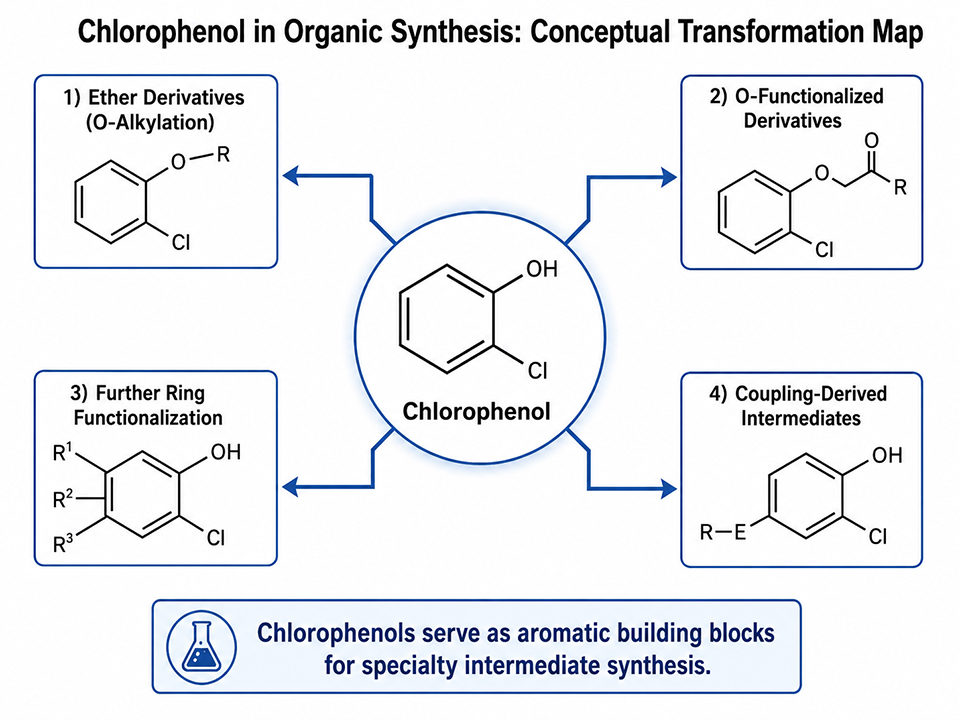
The practical chemistry of chlorophenol building blocks falls into several transformation classes: oxygen functionalization at the phenol, further substitution on the ring, and, in appropriately designed systems, use of the aryl chloride in carbon–carbon or carbon–heteroatom bond formation. Each class is a structural possibility, not a universal industrial recipe.
O-Alkylation and Ether Formation
O-Alkylation converts the phenolic oxygen into a chlorophenol ether. The resulting aromatic ether intermediate keeps the original chlorine position while changing the behavior of the phenolic functionality. In some synthetic routes, masking the phenolic OH can simplify subsequent transformations or improve compatibility with later reaction steps. An ortho-chloroaryl ether keeps chlorine close to the ether oxygen, while a para-chloroaryl ether presents a more linear 1,4-arrangement. That geometric difference can matter for later transformations or the shape of a target intermediate. Ether formation can therefore serve either as a functional-group management strategy or as a route to a distinct aromatic ether intermediate. Exact alkylating agents and conditions belong to process development.
Esterification and Oxygen-Functionalized Derivatives
The phenolic hydroxyl group can also be converted into ester-type derivatives under appropriate chemistry. Esterification changes the functionality of the phenolic oxygen and can create an intermediate that is later cleaved or further transformed. It may be useful when a project requires temporary management of the phenolic group or an oxygen-functionalized aromatic intermediate, but it is not the default industrial use of every chlorophenol. The chlorine substitution pattern remains unchanged, so the derivative still encodes the original 2-, 3- or 4-relationship.
Aromatic Substitution and Further Ring Functionalization
The benzene ring of a monochlorophenol may undergo further functionalization when existing substituents, directing effects and desired regiochemistry are compatible with the reaction mechanism. The phenolic OH is strongly activating and generally ortho/para-directing in electrophilic aromatic substitution, while chlorine is deactivating but also ortho/para-directing. On a free chlorophenol, the hydroxyl group can therefore exert a strong influence on where additional electrophilic substitution occurs. Further halogenation or other ring functionalization should be evaluated according to the required target structure and process design.
Further substitution is superimposed on an already defined OH/Cl pattern. Additional chemistry on 2-chlorophenol creates a more crowded ortho scaffold; 4-chlorophenol retains a 1,4-backbone; and 3-chlorophenol preserves a 1,3-relationship that cannot be obtained by simply exchanging the other two isomers. Directing-effect analysis should therefore begin with the selected isomer rather than with a generic “chlorophenol” structure.
Nucleophilic Aromatic Substitution
Aryl chlorides do not behave like ordinary alkyl chlorides. Nucleophilic aromatic substitution generally depends on ring activation, suitable electron-withdrawing substituents and reaction conditions matched to the mechanism. Simple monochlorophenols contain one chlorine and a strongly electron-donating hydroxyl group, so the aromatic C–Cl bond is not generally activated for straightforward nucleophilic displacement. SNAr should therefore not be treated as a default transformation of monochlorophenols.
If a route depends on efficient displacement of an aryl chloride, the substrate and activation pattern should be evaluated carefully. In other synthesis routes, retaining chlorine through oxygen functionalization or further ring chemistry may be exactly what is required. Claims that “chlorophenols undergo nucleophilic substitution” are incomplete unless the molecular activation and reaction system are specified.
Coupling and Carbon–Carbon / Carbon–Heteroatom Bond Formation
Chlorinated aromatic compounds can participate in catalyst-enabled coupling strategies under suitable conditions. Carbon–carbon and carbon–heteroatom bond formation may be feasible when substrate structure, catalyst system and functional-group management are aligned. Depending on the route, the free phenolic OH may interact with catalysts or participate in competing chemistry, so some synthesis strategies use a protected or otherwise modified phenolic group before the coupling step.
Feasibility is route-specific. Not every isomer is equally suitable for every coupling, and aryl chlorides can require different reaction design from corresponding bromides or iodides in many classical coupling systems. A chlorophenol coupling reaction should therefore be evaluated as a designed transformation rather than as an inherent property of all three commercial isomers.
How the 2-, 3- and 4-Positions Affect Downstream Chemistry
The correct chlorophenol isomer is determined mainly by the desired downstream regiochemistry, not by a generic ranking of reactivity. 2-Chlorophenol, 3-Chlorophenol and 4-Chlorophenol place chlorine adjacent to, meta to, or opposite the phenolic group. That single structural difference changes steric access near the OH group, the geometry of ether or ester derivatives and the substitution map available for later ring chemistry.
| Isomer | Structural Characteristic | Potential Synthetic Implication |
|---|---|---|
| 2-Chlorophenol (o-Chlorophenol, CAS 95-57-8) | Cl adjacent to OH | Greater steric interaction near the phenolic group; creates ortho-substituted downstream scaffolds |
| 3-Chlorophenol (m-Chlorophenol, CAS 108-43-0) | Meta relationship | Provides a defined 1,3-substitution pattern for downstream molecular architecture |
| 4-Chlorophenol (p-Chlorophenol, CAS 106-48-9) | Para relationship | Provides a 1,4-substitution framework and a more linear relationship between the oxygen functionality and chlorine |
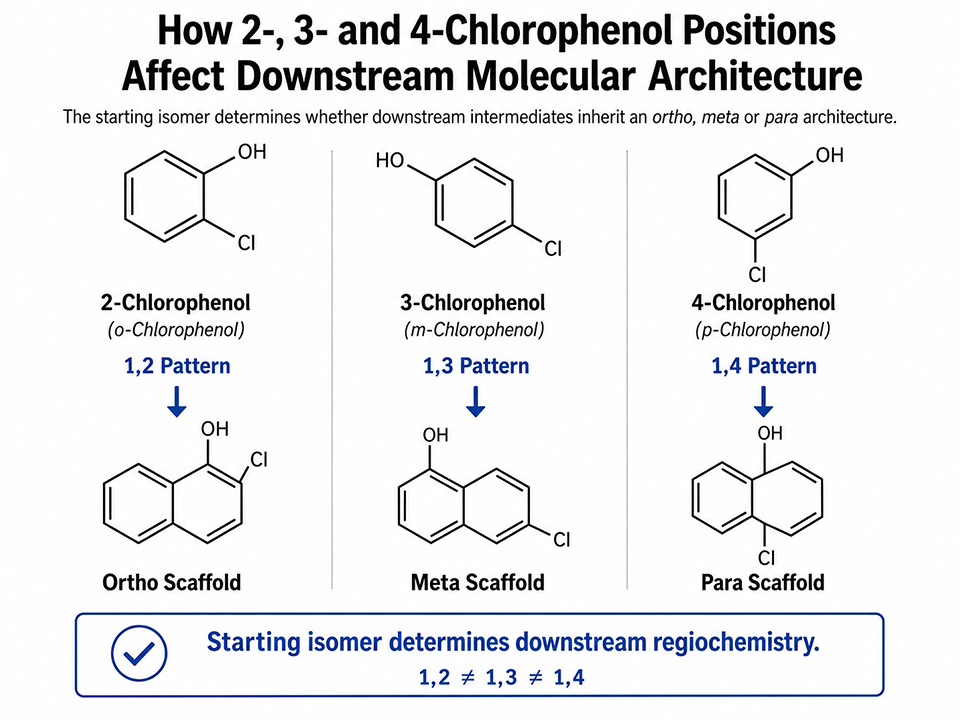
2-Chlorophenol places chlorine beside the hydroxyl group. That proximity can increase steric congestion around the phenolic functionality and around additional substitution close to the existing groups. It is the appropriate starting point when the target requires an adjacent oxygen/chlorine relationship, but it cannot substitute for an isomer designed to produce a meta or para architecture.
3-Chlorophenol provides a defined 1,3-relationship between OH and Cl. It is selected when the downstream target requires that meta substitution pattern. Electronic and steric effects at the meta position differ from those of the ortho and para isomers, and those differences may become relevant depending on the subsequent reaction mechanism.
4-Chlorophenol supplies a 1,4-substitution framework. After ether or ester formation, chlorine remains opposite the oxygen-derived substituent, giving a comparatively linear para relationship. This does not mean that the para isomer is universally easier to process or more reactive. Likewise, the ortho isomer is not universally more reactive and the meta isomer is not simply intermediate between the two. Reactivity depends on mechanism; molecular architecture is fixed by the starting isomer.
When a project moves from conceptual regiochemistry to purchasing a specific material, use how to choose between 2-, 3- and 4-Chlorophenol for procurement-oriented isomer selection. The synthesis decision comes first: determine which substitution pattern the target molecule actually requires.
Chlorophenols in Specialty Chemical Manufacturing
In specialty chemical manufacturing, monochlorophenols can function as platform intermediates for custom synthesis, fine chemical manufacturing and specialty aromatic intermediate production where a defined substitution pattern is required. Their industrial value comes from carrying a known OH/Cl relationship into downstream synthesis while allowing further functionalization according to the process design. That is a chemistry-platform role, not a claim that one chlorophenol isomer serves every end use equally.
Manufacturers care about reproducible substitution patterns because the positional isomer defines the molecular architecture. A process designed around a 1,4-scaffold cannot simply substitute a meaningful amount of the 1,2-isomer without creating a different product family. Residual phenol, another chlorophenol isomer or other organic impurities may also carry into later steps and become increasingly difficult to remove after additional transformations. Batch consistency matters because a route demonstrated at R&D scale may respond differently when impurity profile, moisture or handling behavior changes between lots.
Physical form is also part of process design. 2-Chlorophenol is typically liquid near ordinary ambient temperatures. 3-Chlorophenol is a low-melting, temperature-sensitive material that may be solid, partially melted or liquid depending on storage and handling temperature. 4-Chlorophenol is normally handled as a solid under typical ambient conditions. These differences can affect charging, melting, transfer and packaging decisions. Export shipments and customer quality systems may also require a current COA, SDS and a specification that can be compared with the process requirements. Current specifications, packaging and commercial availability should be confirmed for the specific chlorophenol isomer and project.
What Chemists and Buyers Should Specify When Sourcing a Chlorophenol Building Block
Assay alone is not a sufficient specification for a chlorophenol used in organic synthesis. A high headline purity does not tell a chemist whether the remaining material consists of another positional isomer, residual phenol, moisture or other related impurities. Those distinctions can influence both reaction outcome and downstream purification.
| Requirement | Why It Matters in Organic Synthesis |
|---|---|
| Correct CAS / positional isomer | Determines the regiochemistry of downstream derivatives |
| Assay | Provides a baseline measure of chemical purity but not a complete impurity profile |
| Other chlorophenol isomers | Can create regioisomeric downstream impurities that may become difficult to remove later |
| Residual phenol | May create non-chlorinated downstream derivatives or influence purification requirements |
| Moisture | Relevant to moisture-sensitive reactions, acylation steps and certain catalyst- or reagent-sensitive processes |
| Physical form | Affects charging, melting, transfer and material-handling procedures |
| Batch consistency | Supports process reproducibility from evaluation lots to commercial supply |
| COA / analytical method | Helps confirm that reported assay, isomer composition and relevant impurities match the process requirement |
| Packaging | Should match order quantity, physical form and applicable handling requirements |
| Destination / transport requirements | Important for commercial supply planning and compliant export shipment |
Positional-isomer impurity deserves particular attention. A small amount of the wrong monochlorophenol may undergo the same oxygen-functionalization or ring chemistry as the desired isomer and generate a regioisomeric downstream product. These impurities may have physicochemical properties similar to the desired product and can become increasingly difficult to remove after multiple downstream steps. Residual phenol lacks the chlorine substituent and may generate a parallel family of non-chlorinated derivatives. Moisture may also matter in reaction systems sensitive to water. None of these factors is visible in an assay number taken in isolation.
Where these parameters are important, buyers should review a representative or current COA, understand the analytical method used to distinguish positional isomers, and request available information on relevant organic impurities, moisture or appearance. Current specifications, packaging and commercial availability should be confirmed for the specific chlorophenol isomer and project.
From R&D Evaluation to Commercial Supply
A typical evaluation workflow may include identifying the target isomer from the required molecular architecture, defining the critical specification, reviewing a representative or current COA and analytical method, evaluating a sample where appropriate, confirming packaging and quantity requirements, checking export and transport conditions, and moving to commercial supply after technical approval.
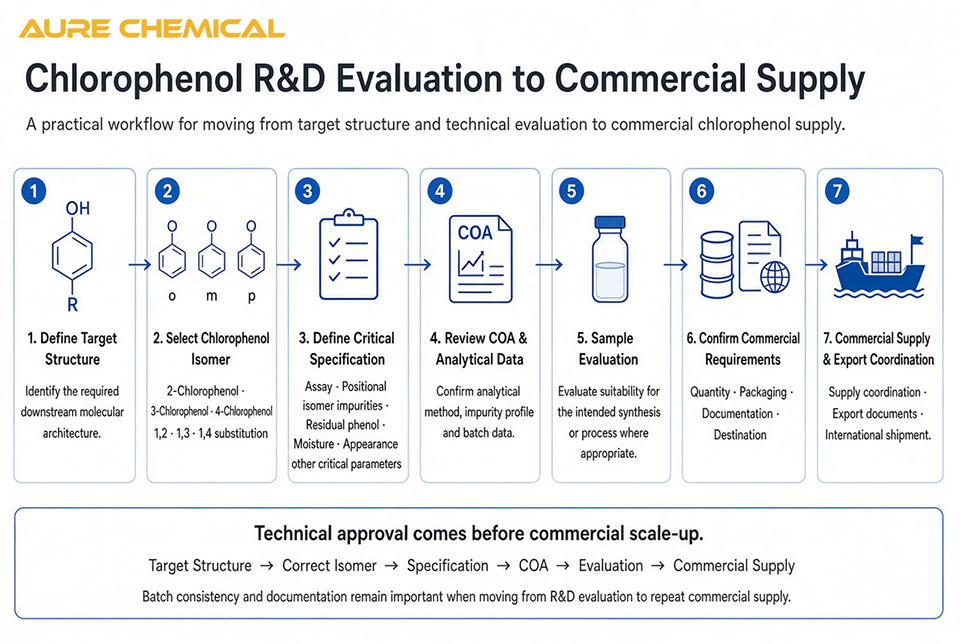
R&D sample approval does not automatically guarantee industrial process suitability. Scale-up introduces different charging, transfer and purification conditions, while commercial lots must also demonstrate that critical quality parameters remain compatible with the approved process. Batch consistency is therefore part of technical evaluation, not only a commercial preference.
Aure Chemical is a China-based specialty chemical supplier, exporter and sourcing partner. For chlorophenol building-block projects, Aure Chemical can support sourcing coordination, specification communication, COA review, SDS and available TDS documentation, sample coordination where feasible, commercial quotation and export shipment coordination. Current specifications, packaging and commercial availability should be confirmed for the specific isomer and project.
Frequently Asked Questions About Chlorophenols in Organic Synthesis
Why are chlorophenols useful building blocks in organic synthesis?
Chlorophenols combine a phenolic OH group, an aromatic chlorine substituent and a defined substitution pattern on one benzene ring. This allows chemists to functionalize the oxygen, retain or potentially use the aromatic chlorine in later chemistry, and carry a defined ortho, meta or para architecture into downstream specialty intermediates. Their usefulness comes from this combination of structural features rather than from unrestricted reactivity at every site.
What functional groups are present in chlorophenols?
Each monochlorophenol contains a phenolic hydroxyl group and one aromatic chlorine substituent on a benzene ring, with molecular formula C6H5ClO. The difference among 2-, 3- and 4-Chlorophenol is the relative position of those two groups. That positional relationship determines the molecular architecture carried into downstream derivatives.
Can chlorophenols be converted into ethers?
Yes. The phenolic oxygen can be converted into a chlorophenol ether under suitable reaction conditions. The resulting aromatic ether retains the original chlorine position and therefore preserves the starting isomer's ortho, meta or para substitution pattern. Ether formation may be used either to create a desired downstream intermediate or to manage the phenolic functionality before later reaction steps.
Can the aromatic chlorine in chlorophenol participate in coupling reactions?
It may participate in coupling chemistry when the substrate, catalyst system and reaction design are appropriate. Aryl chlorides generally require different considerations from more reactive aryl halides, and the free phenolic OH may also need functional-group management depending on the reaction. Coupling feasibility should therefore be evaluated for the specific isomer and synthesis route rather than assumed for all chlorophenols.
Are 2-, 3- and 4-Chlorophenol interchangeable in a synthesis route?
No. The three compounds are positional isomers that create different downstream regiochemistry. 2-Chlorophenol provides an ortho 1,2-pattern, 3-Chlorophenol provides a meta 1,3-pattern and 4-Chlorophenol provides a para 1,4-pattern. Substituting one isomer for another changes the molecular architecture of downstream products rather than merely changing a physical property of the starting material.
How should I choose a chlorophenol isomer for a new synthesis project?
Start by mapping the substitution pattern required in the target molecule, then select the chlorophenol isomer that already contains the corresponding relationship between the oxygen functionality and chlorine. After the molecular architecture is fixed, compare impurity requirements, physical handling characteristics and documentation. For a procurement-focused comparison, see how to choose between 2-, 3- and 4-Chlorophenol.
Why does positional isomer purity matter?
Another monochlorophenol isomer can undergo similar downstream transformations and generate a regioisomeric impurity alongside the desired product. These regioisomeric impurities may have physicochemical properties similar to the target material and can become increasingly difficult to remove after multiple downstream steps. Controlling positional-isomer composition in the starting material can therefore be important for route reproducibility and downstream purification.
What information should I provide when requesting a chlorophenol for R&D or industrial synthesis?
Provide the target isomer or CAS number, required specification, critical impurity limits if known, intended application or general reaction type, evaluation quantity, expected commercial requirement, destination country or port, and documentation needs such as COA, SDS or additional analytical information. This helps match the material to the technical requirements of the project rather than to a generic catalog specification.
Discuss Your Chlorophenol Requirement
If you are evaluating a chlorophenol as an aromatic building block, share the information that determines both chemistry and supply. Useful details include the target isomer or CAS number, required specification, critical impurity limits, intended application or general reaction type, evaluation quantity, expected commercial requirement, destination country or port, and documentation requirements.
Aure Chemical can help coordinate suitable supply options and technical documentation as a China-based chemical supplier, exporter and sourcing partner. You can request a current specification, request a COA, discuss your application or request a commercial quotation for the chlorophenol isomer that matches your target structure.