

Chlorophenols for Dyes & Pigment Intermediate Synthesis | Aure Chemical
Monochlorophenols can serve as substituted aromatic intermediates in selected dye, pigment and colorant-intermediate synthesis routes. They are not finished dyes, pigments or colorants. Their value lies in providing a defined chlorinated phenolic scaffold that can be functionalized further. Because 2-Chlorophenol, 3-Chlorophenol and 4-Chlorophenol place chlorine at different positions relative to the phenolic hydroxyl group, each isomer represents a different starting architecture rather than a different grade of the same raw material.
Material qualification is therefore more than an assay number. Impurity profile — especially other monochlorophenol isomers and residual phenol — may influence downstream intermediate composition. Batch consistency in critical attributes supports repeat production. Appearance and color can be useful receiving observations, but they do not replace chemical analysis and do not predict the shade of a finished colorant. This page focuses on upstream aromatic-intermediate chemistry, material qualification and industrial sourcing. For chemical identity and a broader comparison, see the overview of 2-, 3- and 4-Chlorophenol isomers.
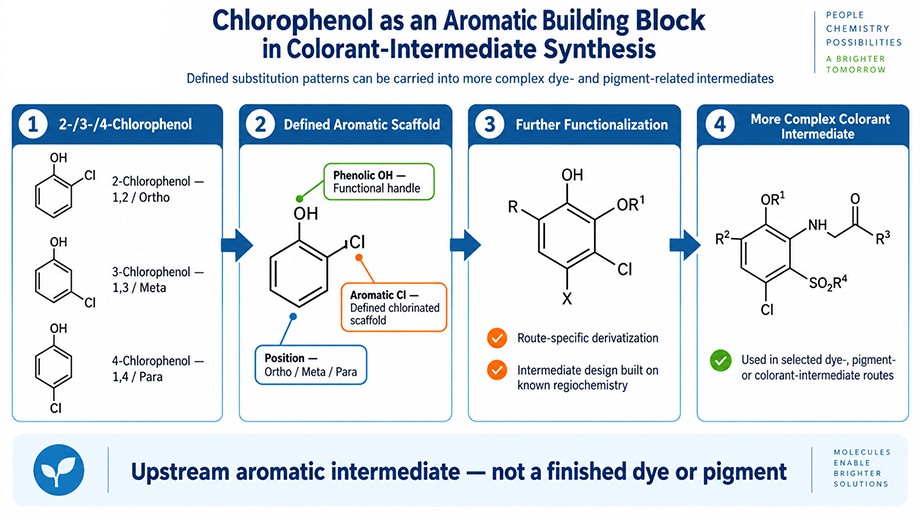
Why Chlorophenols Are Useful Aromatic Intermediates in Colorant Synthesis
Chlorophenols provide a defined chlorinated aromatic framework together with a phenolic functional group, making them useful upstream building blocks in selected dye, pigment and colorant-intermediate synthesis routes.
Their value comes from three structural features:
a benzene ring that provides a defined aromatic framework for further functionalization;
a phenolic hydroxyl group that can serve as a functional handle for downstream derivatization;
an aromatic chlorine substituent that establishes a defined ring position and may remain in the downstream scaffold or participate in route-specific transformations.
The value of a monochlorophenol is therefore structural rather than chromatic. The parent compounds themselves do not provide a commercial dye or pigment shade. What they provide is regiochemical definition. Once chlorine is positioned at the 2-, 3- or 4-position relative to the hydroxyl group, subsequent chemistry begins from a known aromatic substitution pattern.
Fixing that relationship early can reduce the number of regiochemical decisions that must be addressed after additional substituents have been introduced. Whether that structure is useful depends entirely on the required downstream intermediate.
Use is route-specific rather than universal. Many dye and pigment intermediates originate from other phenolic, aromatic amine, naphthalene, anthraquinone or heterocyclic starting materials. A chlorophenol is relevant only where the required structure benefits from its particular OH/Cl substitution pattern or where it serves as a useful precursor to another substituted aromatic intermediate.
For a broader discussion of downstream functionalization possibilities, see chlorophenols as building blocks in organic synthesis.
Where downstream quality depends on exact isomer identity and impurity profile, the starting chlorophenol may need to be treated as a controlled raw material rather than simply as a generic commodity phenol.
Why the Correct Isomer Matters in Dye and Pigment Intermediate Routes
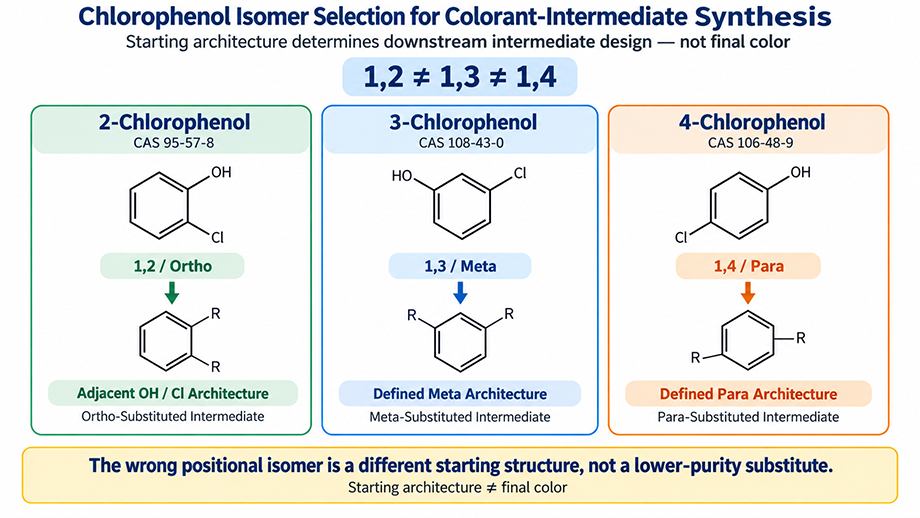
2-Chlorophenol, 3-Chlorophenol and 4-Chlorophenol share the molecular formula C6H5ClO, but they are different chemicals. The chlorine atom occupies a different position relative to the phenolic hydroxyl group, so each isomer presents a different molecular architecture to the next synthesis step.
| Isomer | Starting Architecture | Potential Route Relevance |
|---|---|---|
| 2-Chlorophenol (o-Chlorophenol, CAS 95-57-8) | 1,2 / Ortho | Provides an adjacent OH/Cl relationship for routes requiring an ortho aromatic framework |
| 3-Chlorophenol (m-Chlorophenol, CAS 108-43-0) | 1,3 / Meta | Provides a defined meta scaffold for routes requiring a 1,3 relationship |
| 4-Chlorophenol (p-Chlorophenol, CAS 106-48-9) | 1,4 / Para | Provides a para aromatic framework for routes requiring a 1,4 relationship |
The wrong positional isomer is a different starting material, not a lower-purity version of the correct isomer. If a route is designed around a para relationship between OH and Cl, a meta or ortho feed changes the relative position of those groups from the first step onward. Downstream intermediates derived from the wrong isomer are regioisomeric structures rather than merely lower-grade versions of the intended intermediate.
This matters because later substitution patterns and molecular geometry are built on the starting ring map. Selecting the isomer is therefore a structural design decision rather than a color decision.
Ortho, meta and para do not correspond to red, blue, yellow or any other final shade. If a finished colorant is ultimately produced, its color depends on the complete molecular structure, chromophore, substituent pattern, physical form, downstream processing and application system.
Buyers who need a side-by-side comparison of physical form, handling and broader procurement considerations can use how to choose between 2-, 3- and 4-Chlorophenol. This page remains focused on why molecular architecture matters in colorant-intermediate manufacturing.
Dye Intermediate and Pigment Intermediate Are Different Roles
Dyes and pigments are not interchangeable terms, and a chlorophenol itself occupies neither role. It can sit upstream of either value chain when the selected synthesis begins from a monochlorophenol scaffold.
In a dye value chain, an intermediate may eventually contribute to a molecule intended to function in soluble or molecularly dispersed form in the relevant application medium. In a pigment value chain, an intermediate may eventually contribute to an insoluble colorant structure intended for particulate use and dispersion in a medium.
These end-use classes differ in solubility behavior, application method and performance requirements, although early synthetic stages may use similar types of aromatic building blocks.
A chlorophenol used in either route remains an upstream aromatic intermediate or raw material. It is not itself a textile dye, paint pigment, colorant additive or shade-producing component. Search phrases such as “chlorophenol dye intermediate” or “chlorophenol pigment intermediate” should therefore be understood as referring to chlorophenol used as a starting material or early intermediate in a route leading toward a dye-related or pigment-related molecule.
Keeping this distinction clear helps buyers specify the raw material correctly. Exact CAS number, positional-isomer profile, residual phenol, related organics, moisture where relevant and batch consistency describe the incoming aromatic material. They do not directly predict the coloristic properties of the finished colorant.
Purity and Impurity Profile in Colorant-Intermediate Manufacturing
Assay is an important baseline parameter, but it does not fully define material suitability. It indicates how much of the named isomer is present without necessarily identifying the remaining material. In colorant-intermediate manufacturing, the identity of those remaining components can matter because some impurities may participate in related downstream chemistry.
Positional-isomer impurities deserve particular attention. Another monochlorophenol isomer may undergo similar phenolic or aromatic transformations and generate a regioisomeric companion intermediate. That companion may persist through subsequent steps, increase impurity burden, complicate purification or add analytical peaks that must be understood during process control.
The important risk is not that the wrong isomer automatically changes the final color. The more defensible concern is that a different starting architecture may create a different downstream molecular composition. Whether that material persists, is removed or affects later quality depends on the actual synthesis route.
Residual phenol is the non-chlorinated parent compound. Depending on the route, residual phenol may undergo parallel chemistry and generate non-chlorinated downstream impurities. In some processes these may be removed readily; in others they may persist or generate downstream impurities that require explicit control.
Moisture matters where the next synthesis step or reagent system is sensitive to water. It is not automatically a critical parameter for every colorant-intermediate process. Water content should therefore be evaluated according to the intended chemistry rather than used as a universal quality ranking.
Related organic impurities and unidentified analytical peaks form part of the incoming impurity fingerprint. A changing impurity pattern from lot to lot may influence downstream processing, isolated-intermediate quality or the effort required to meet a later specification.
The objective is not to demand an exhaustive impurity list before any technical evaluation has taken place. It is to understand whether the supplier can characterize and consistently communicate the impurity profile that matters to the customer’s qualified process.
Applicable limits should be defined in the buyer’s specification and agreed analytical documentation. Assay alone does not fully describe the material entering the next synthesis step.
Appearance and Color — Useful QC Observation, but Not a Complete Specification
Raw-material appearance and color can be useful receiving observations, but they do not by themselves establish chlorophenol purity or predict final dye or pigment shade.
Visual appearance is commonly used as a supporting receiving observation because unexpected darkening, haze or a change in physical state can justify further review. However, visual inspection does not replace identity testing or analytical measurement.
Color cannot identify which positional isomer is present. Two lots that appear visually similar may still differ in positional-isomer profile or related organic impurities. Conversely, two lots that show a modest appearance difference may both remain within an agreed chemical specification.
Physical state also depends on the specific isomer and temperature. A visible change in form may result from warehouse, transit or ambient temperature rather than from chemical degradation. Appearance should therefore be interpreted against the expected physical behavior of the exact CAS number being received.
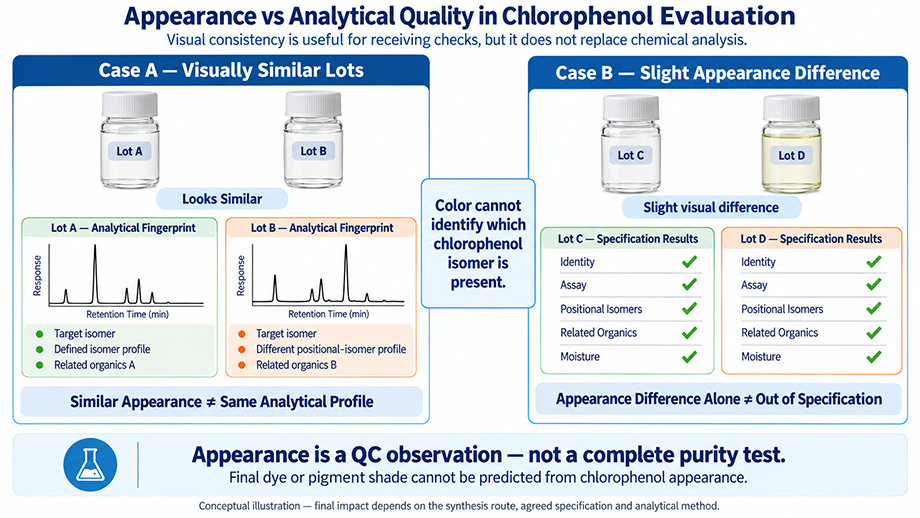
If a finished colorant is eventually produced, its shade depends on the completed molecular structure, chromophore, substitution pattern, downstream processing and application system. The appearance of an incoming chlorophenol raw material does not directly determine that color.
Raw-material appearance belongs primarily to receiving and quality-control observation. Finished colorant shade belongs to downstream color chemistry. Treating the two as equivalent can lead to incorrect material-quality conclusions.
Can Raw-Material Impurities Affect Final Colorant Quality?
Raw-material impurities may influence downstream intermediate composition and process consistency, but their effect on finished color or colorant performance is route-specific.
A useful conceptual sequence is:
a raw-material impurity is capable of entering related downstream chemistry;
a parallel intermediate is generated from that impurity;
the parallel intermediate persists through one or more later steps;
a corresponding downstream impurity remains in an isolated intermediate or, potentially, in the final colorant system.
Every step in this sequence is conditional. An impurity removed during an early isolation may never affect a later intermediate. Another impurity may persist through several steps and require additional analytical or purification attention.
Possible consequences may include higher impurity burden, different intermediate composition or additional process-control requirements. Only where an impurity survives sufficiently far into the final colorant system could it potentially affect colorant quality, and even then the effect depends on its structure, concentration and the complete application system.
This page therefore does not assign universal hue changes, shade shifts, brightness changes or color-strength effects to individual chlorophenol impurities. Such conclusions require route-specific evidence.
Buyers can still manage this risk without disclosing confidential formulations by identifying which impurity classes are critical to their process and requesting that those parameters be addressed in the specification and COA discussion.
Batch Consistency in Repeat Dye and Pigment Intermediate Production
Repeat manufacturing benefits when incoming chlorophenol remains within the critical material attributes established during qualification. Depending on the route, these attributes may include assay, positional-isomer profile, residual phenol, moisture, related organic impurities and an agreed appearance range used as a supporting receiving observation.
Consistency should primarily mean analytical consistency against agreed limits rather than photographic similarity between packages or lots. Two lots can look alike while differing in an impurity that cannot be seen visually. Conversely, a modest appearance difference that remains within the qualified chemical and physical window does not automatically justify rejection.
Repeat supply also benefits from an analytical method capable of consistently resolving the impurities that matter to the process. If the original qualification uses a method that distinguishes critical positional isomers but later commercial data do not provide comparable resolution, a headline assay alone may not demonstrate that the impurity profile remains equivalent.
Sample approval establishes a reference quality profile; it does not automatically qualify every future commercial lot. Buyers expecting multi-lot or repeat supply should define which critical attributes future material must continue to meet.
Analytical Information Buyers May Review
Analytical-method fitness matters more than the technique name alone. GC, HPLC or another fit-for-purpose analytical method may be appropriate if it can identify the named isomer and adequately resolve the impurities that matter to the customer’s process.
| Quality / Analytical Item | Why It May Matter |
|---|---|
| Assay | Confirms the level of the target chlorophenol isomer |
| Positional-isomer profile | Supports control of unwanted ortho, meta or para isomers |
| Residual phenol | Identifies a potential non-chlorinated precursor impurity |
| Moisture | May be relevant to water-sensitive processing |
| Related organic impurities | Helps define the incoming impurity fingerprint |
| Appearance / color | Provides a supporting receiving observation |
| Analytical method | Determines whether critical impurities are adequately resolved and quantified |
| Batch identification | Supports traceability |
Buyers do not need to prescribe a universal GC or HPLC procedure on a general application page. They do need to understand whether the reported analytical data distinguish 2-, 3- and 4-Chlorophenol when that distinction is critical to the process.
A report containing only a generic “chlorophenol assay” is not equivalent to analytical information that clearly identifies the exact CAS number and reports relevant positional-isomer impurities separately where required.
Current specifications and available analytical information should be confirmed for the specific isomer and project.
From Sample Evaluation to Repeat Commercial Supply
A structured qualification process helps connect laboratory evaluation with commercial raw-material control.
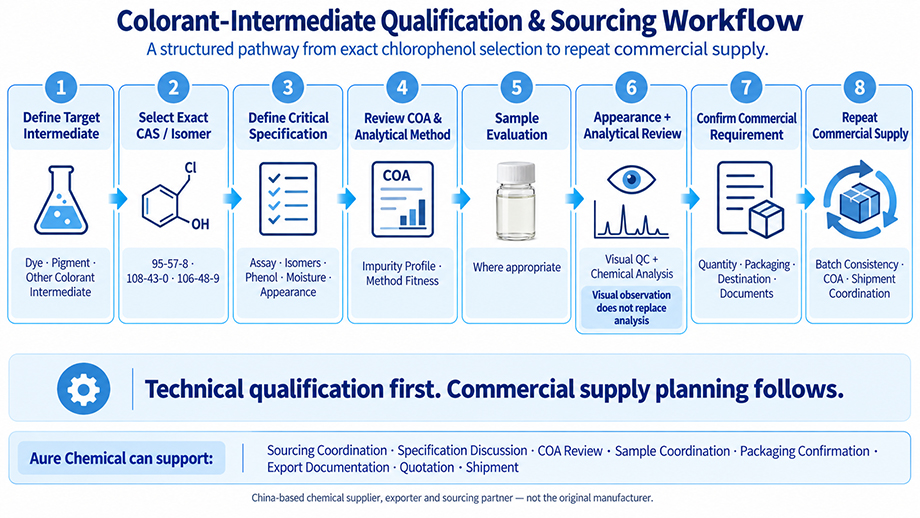
A typical evaluation pathway may include:
identifying the exact chlorophenol and CAS number;
defining the quality parameters that matter to the route;
reviewing the available specification and a representative or current COA;
evaluating a sample where the project justifies it;
confirming that the analytical method aligns with the critical impurity requirements;
establishing commercial acceptance criteria;
moving to repeat supply against those agreed criteria.
Sample approval does not automatically define every future commercial lot. It provides a technical reference point. Subsequent material should be evaluated against the agreed critical quality attributes rather than against visual memory of the original sample.
If the first commercial quantity will enter a qualified production process, buyers should define how the commercial lot will be evaluated relative to the sample or representative material used during technical qualification.
Packaging, Handling and Transport
Physical form differs among the three monochlorophenol isomers, so packaging and handling should be planned around the exact product rather than around a generic assumption that all chlorophenols behave identically.
Packaging also depends on commercial quantity, destination, storage conditions, receiving capability and applicable transportation requirements. Current transport requirements should be confirmed from the applicable SDS and shipping documentation for the exact isomer being offered.
Specific drum sizes, container payloads, dangerous-goods classifications and freight arrangements belong to the current commercial offer and shipment documentation rather than to a general application page.
For a detailed comparison of physical form and handling considerations, see how to choose between 2-, 3- and 4-Chlorophenol.
Documentation for Dye and Pigment Intermediate Projects
Documentation requirements vary according to destination, customer quality system and whether the chlorophenol will enter a qualified manufacturing process. Not every project requires every document listed below.
| Document / Information | Typical Purpose |
|---|---|
| Product specification | Defines required or agreed quality parameters |
| Representative / current COA | Provides available batch analytical information |
| SDS | Provides safety, handling and transport information |
| TDS if available | Provides additional technical product information |
| Analytical method information | Supports assessment of impurity differentiation |
| Appearance information | Provides a receiving reference where relevant |
| Batch identification | Supports lot traceability |
| Packaging information | Supports receiving, storage and logistics planning |
| Commercial invoice / packing list | Supports international shipment documentation |
| DG documentation where applicable | Supports transport compliance where required |
| Certificate of Origin where required | May support customs or trade requirements |
Specification, representative or current COA, SDS and relevant analytical information are common starting points for technical evaluation. Additional shipment and trade documentation should then be confirmed according to product, destination and transaction requirements.
Evaluating a Chlorophenol Supplier for Colorant Projects
Industrial buyers may evaluate more than unit price when selecting chlorophenol for dye, pigment or other colorant-intermediate manufacturing. Important considerations can include exact CAS identification, specification communication, positional-isomer control, impurity-profile information, analytical documentation, batch consistency, sample coordination, packaging suitability, export documentation and repeat-supply capability.
Price should normally be compared after technical suitability has been established. A lower-priced offer is not technically equivalent if the available analytical method or documentation cannot distinguish the target isomer from critical positional-isomer impurities required by the customer’s process.
Appearance can also form part of receiving control, but visual similarity should not substitute for analytical documentation when isomer identity or related-organic impurities are critical.
Aure Chemical is a China-based chemical supplier, exporter and sourcing partner. It can support buyers with sourcing coordination, specification discussion, representative or current COA review, sample coordination where feasible, packaging confirmation, commercial quotation, export documentation and international shipment coordination.
Aure Chemical is not the original manufacturer of the chlorophenols discussed on this page and is not a dye, pigment or colorant producer. Current specifications, packaging options and commercial availability should be confirmed for the exact isomer, quantity and destination.
What Buyers Should Include in a Chlorophenol RFQ
A technically useful chlorophenol inquiry should identify the exact raw material and the quality parameters that matter to the downstream colorant-intermediate process.
exact chemical name and CAS number;
target specification or critical quality attributes;
positional-isomer limits if relevant to the route;
residual phenol requirement if relevant;
moisture requirement if relevant;
appearance or color requirement if used as a receiving criterion;
broad downstream application category, such as dye intermediate, pigment intermediate or another colorant intermediate;
qualification or sample quantity if applicable;
initial commercial quantity and expected annual or repeat requirement;
destination country or port;
packaging preference or receiving-site constraints;
required technical, commercial and shipment documentation;
required delivery window.
Confidential formulations do not need to be disclosed. A broad application description together with the exact CAS number and specification is normally sufficient for an initial sourcing discussion. The application category helps identify which quality parameters may require additional discussion without requiring disclosure of the complete production route.
Frequently Asked Questions About Chlorophenol Dye and Pigment Intermediates
Why are chlorophenols used as dye or pigment intermediates?
In selected synthesis routes, chlorophenols can serve as substituted phenolic building blocks. Their combination of a defined aromatic chlorine position and phenolic hydroxyl functionality provides a known starting architecture for further derivatization. Their use is route-specific rather than universal across dye and pigment chemistry.
Are chlorophenols themselves dyes or pigments?
No. Monochlorophenols are upstream aromatic raw materials or intermediates. They are not finished dyes, pigments, textile colorants, paint pigments or colorant additives.
What is the difference between a dye intermediate and a pigment intermediate?
The distinction relates to the downstream colorant system. A dye-related intermediate may contribute to a colorant intended to function in soluble or molecularly dispersed form, while a pigment-related intermediate may contribute to an insoluble particulate colorant. A chlorophenol can sit upstream of either route without itself having a dyeing or pigmenting function.
Are 2-, 3- and 4-Chlorophenol interchangeable?
No. They are different CAS-identified positional isomers with different substitution patterns. Replacing one with another changes the starting molecular architecture and can create different downstream structures.
Which chlorophenol isomer should be selected?
Select the isomer whose OH/Cl positional relationship matches the required downstream intermediate. 2-Chlorophenol provides a 1,2 / ortho relationship, 3-Chlorophenol provides a 1,3 / meta relationship and 4-Chlorophenol provides a 1,4 / para relationship. For broader specification, physical-form and procurement considerations, see how to choose between 2-, 3- and 4-Chlorophenol.
Does the chlorophenol isomer determine the final color?
No. The chlorophenol isomer determines the starting molecular architecture. If a finished colorant is later produced, its final shade depends on the complete molecular structure, chromophore, other substituents, downstream processing and the application system.
Can impurity profile affect colorant manufacturing?
It may. Positional-isomer impurities, residual phenol or other related organics can generate parallel downstream impurities depending on the synthesis route. Whether those species survive into later intermediates or affect final colorant quality depends on subsequent chemistry and purification. There is no universal shade rule.
Is appearance or color enough to judge chlorophenol quality?
No. Appearance can be a useful receiving observation, but chemical identity, target-isomer content and impurity profile require analytical evaluation. Visually similar material can have different impurity profiles, while modest appearance differences do not automatically indicate chemical failure.
Why does batch consistency matter?
Repeat intermediate production is generally easier to control when incoming raw material remains within the critical attributes established during qualification. Material changes in isomer profile, residual phenol, moisture or related organic impurities may alter downstream impurity burden or process-control requirements even if visual appearance remains similar.
What documentation should industrial buyers request?
Typical starting documents include the product specification, a representative or current COA, SDS and clear batch identification. Depending on the project, buyers may also request analytical-method information, appearance references, packaging information and applicable export or transport documentation.
Discuss Your Chlorophenol Requirement
If you are qualifying a monochlorophenol as a starting material or aromatic intermediate for a dye, pigment or other colorant-intermediate project, provide the exact CAS number, target specification, critical impurity requirements, broad application category, quantity, destination, packaging requirements and documentation needs.
Aure Chemical can help coordinate suitable sourcing, technical specification discussion, representative or current COA review, sample coordination where feasible, commercial quotation, documentation and international shipment as a China-based chemical supplier, exporter and sourcing partner.