

How to Select 2-, 3- or 4-Chlorophenol for Industrial Use | Aure Chemical
The correct chlorophenol isomer is the one whose ortho, meta or para substitution pattern matches the required downstream molecule. 2-Chlorophenol, 3-Chlorophenol and 4-Chlorophenol are positional isomers of C6H5ClO. They share the same formula and molecular weight, but they are not interchangeable starting materials. A 1,2-relationship cannot be converted into a 1,4-relationship by raising assay, and a meta architecture cannot be purchased under an ortho CAS number.
Once the required substitution pattern is fixed, industrial selection becomes a procurement problem: physical form, impurity identity, moisture, packaging, documentation and supply conditions. Headline purity is not enough. A small amount of another positional isomer can travel through the same downstream chemistry and create regioisomeric impurities that may become difficult to remove later in the synthesis. This page is a practical framework for moving from “I need a chlorophenol” to a defined isomer, specification and inquiry. For chemical identity and a broader isomer overview, see the overview of 2-, 3- and 4-Chlorophenol isomers.
Quick Comparison of 2-, 3- and 4-Chlorophenol
A busy buyer can separate the three isomers first by substitution pattern and typical handling form, then open the matching product page. Approximate melting behavior below is based on literature values and should not be treated as an Aure Chemical product specification.
| Selection Factor | 2-Chlorophenol | 3-Chlorophenol | 4-Chlorophenol |
|---|---|---|---|
| Positional relationship | 1,2 / Ortho | 1,3 / Meta | 1,4 / Para |
| CAS No. | 95-57-8 | 108-43-0 | 106-48-9 |
| Typical physical behavior near ambient temperature | Usually handled as a liquid | May be solid, partially melted or liquid, depending on warehouse temperature | Usually handled as a solid |
| Approx. melting behavior (literature) | About 7–9 °C | About 33–35 °C | About 43 °C |
| Downstream architecture | Ortho-substituted scaffold | Meta-substituted scaffold | Para-substituted scaffold |
| Main handling implication | Liquid charging, pumping and containment planning | Temperature-sensitive sampling, storage and transfer | Solid charging or controlled melting before transfer |
| Product page | 2-Chlorophenol (o-Chlorophenol, CAS 95-57-8) | 3-Chlorophenol (m-Chlorophenol, CAS 108-43-0) | 4-Chlorophenol (p-Chlorophenol, CAS 106-48-9) |
Literature sources may report slightly different melting points. Use these values for general selection context only. Confirm current appearance, specification and handling information against the applicable product documentation and batch information.
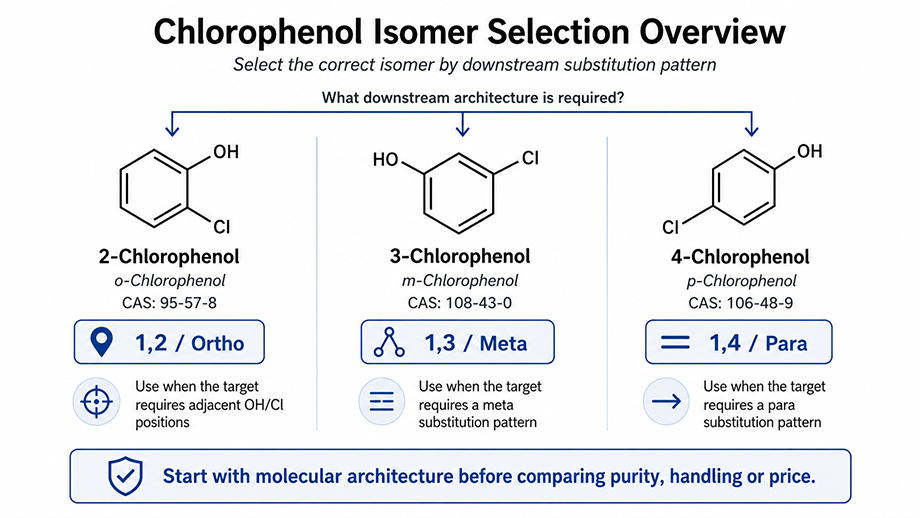
Step 1 — Start With the Required Molecular Architecture
Select the isomer whose ortho, meta or para substitution pattern matches the target molecule before comparing price, packaging or headline purity. 1,2 ≠ 1,3 ≠ 1,4. Where regiochemistry matters, the three isomers are not substitutes for one another.
2-Chlorophenol (o-Chlorophenol, CAS 95-57-8) places chlorine next to the phenolic hydroxyl group. That 1,2 relationship is the appropriate starting point when the downstream intermediate requires adjacent oxygen and chlorine substitution. The same proximity also creates greater steric interaction around the phenolic functionality. This may matter in later chemistry, but it is not a reason to reject the isomer when the target architecture itself is ortho.
3-Chlorophenol (m-Chlorophenol, CAS 108-43-0) contains a defined 1,3 / meta relationship between OH and Cl. Select it when the target structure requires a meta substitution pattern that cannot be provided by the ortho or para isomer. Meta substitution is not a compromise between the other two isomers. It is a different molecular architecture.
4-Chlorophenol (p-Chlorophenol, CAS 106-48-9) supplies a 1,4 / para relationship. After O-functionalization, the chlorine remains opposite the oxygen-derived substituent, creating a para-substituted aromatic framework. Para is not “higher quality” because it is normally handled as a solid, and it is not automatically easier to use in every reaction.
If the project is still at route-design stage rather than purchasing stage, review chlorophenols as building blocks in organic synthesis for the chemical logic behind oxygen functionalization, ring chemistry and route-dependent aryl-chloride reactivity. Return to this selection guide when the required architecture is known and the procurement specification must be defined.
Step 2 — Consider Physical Form and Process Temperature
Physical form is a process consideration, not a reason to buy the wrong molecular isomer. After the substitution pattern is fixed, melting behavior can influence charging, warehouse storage, sampling and transfer. Do not select 2-Chlorophenol only because liquid handling is convenient if the target molecule requires 4-Chlorophenol.
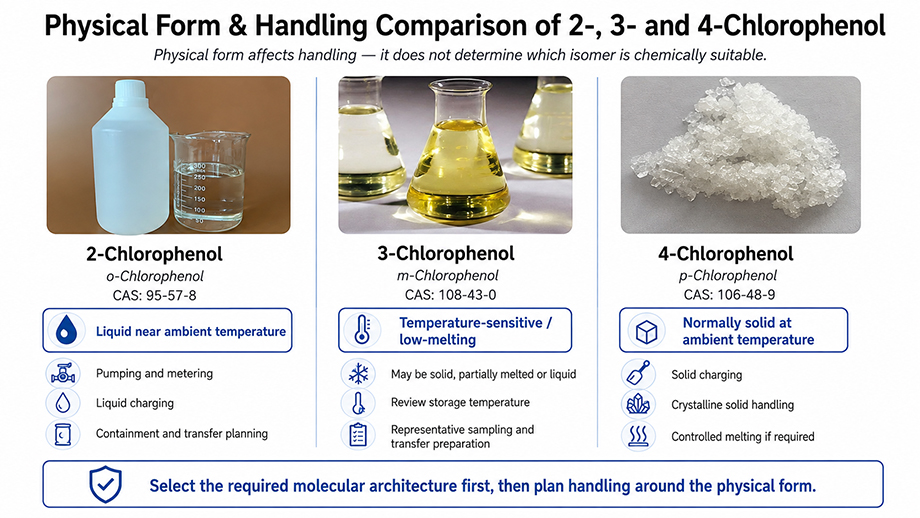
2-Chlorophenol melts well below ordinary room temperature and is generally handled as a liquid under common ambient conditions. This can simplify pumping, metering and liquid charging in facilities designed for liquid feed. It also means containment, closure integrity and transfer procedures should be appropriate for liquid handling. Liquid form is convenient for some plants and less convenient for others. It is not an indicator of higher chemical quality.
3-Chlorophenol is the most temperature-sensitive of the three from a physical-form perspective. Its melting range lies close to common warehouse and plant temperatures, so the same material may be present as a solid, a partially melted mass or a liquid depending on storage and transit conditions. This is a handling characteristic rather than an impurity signal by itself. Warehouse temperature, representative sampling and transfer preparation should therefore be considered when evaluating the material.
4-Chlorophenol is normally handled as a solid under typical ambient conditions. Process implications may include solid charging or controlled melting before transfer where the receiving plant is designed for liquid feed. Solid form does not mean higher purity than a liquid isomer. Match the physical handling system to the isomer already required by the downstream molecule.
Step 3 — Define the Required Quality Specification
Headline assay alone is not enough to define a chlorophenol specification. Positional-isomer contamination and the identity of other impurities may be more important to a particular downstream process than a small difference in reported assay. “Purity ≥99%” by itself is therefore not a complete procurement specification for industrial chlorophenol use.
Assay is a baseline measure of chemical purity. It indicates how much of the named compound is present, but it does not identify what makes up the remainder. Two lots with the same assay can differ in residual phenol, another monochlorophenol isomer, moisture or other related impurities.
Positional-isomer impurities are one of the most important technical buying factors when downstream regiochemistry matters. A small amount of 2-Chlorophenol in a 4-Chlorophenol batch, or 3-Chlorophenol in a 2-Chlorophenol batch, may undergo similar downstream transformations and generate a regioisomeric product. Those downstream impurities can become increasingly difficult to remove after additional reaction steps. Buyers should therefore understand whether the analytical method used can adequately distinguish the relevant chlorophenol isomers.
Residual phenol does not contain the chlorine substituent present in monochlorophenols. Depending on the downstream route, it may participate in parallel chemistry and generate non-chlorinated derivatives or increase purification requirements. A numerical phenol limit should be based on the needs of the intended process rather than assumed from a generic catalog specification.
Moisture can matter in moisture-sensitive routes, some catalyst- or reagent-sensitive systems, and certain acylation or oxygen-functionalization steps. Its relevance depends on the intended chemistry. Where water content is process-critical, the requirement should be defined in the inquiry and reviewed against the applicable analytical data.
Color and appearance can be useful receiving observations, but they should not replace analytical data. A visually acceptable lot may still contain another positional isomer, while a difference in appearance does not automatically indicate that an agreed chemical specification has failed.
Analytical method belongs in the specification discussion. The important question is not simply whether a particular technique name appears on the COA, but whether the method used is capable of separating the relevant positional isomers and quantifying the impurities that matter to the process. Where impurity differentiation is critical, buyers should understand the analytical method and how key components are reported. Current specifications should be confirmed for the specific isomer and project. Literature values and generic catalog grades should not be treated as Aure Chemical guaranteed specifications.
Assay vs. Impurity Profile — Why the Difference Matters
Equal assay does not necessarily mean equal process suitability. Two chlorophenol lots can carry the same headline purity while presenting different impurity profiles and therefore different risks in a regiochemistry-sensitive route.
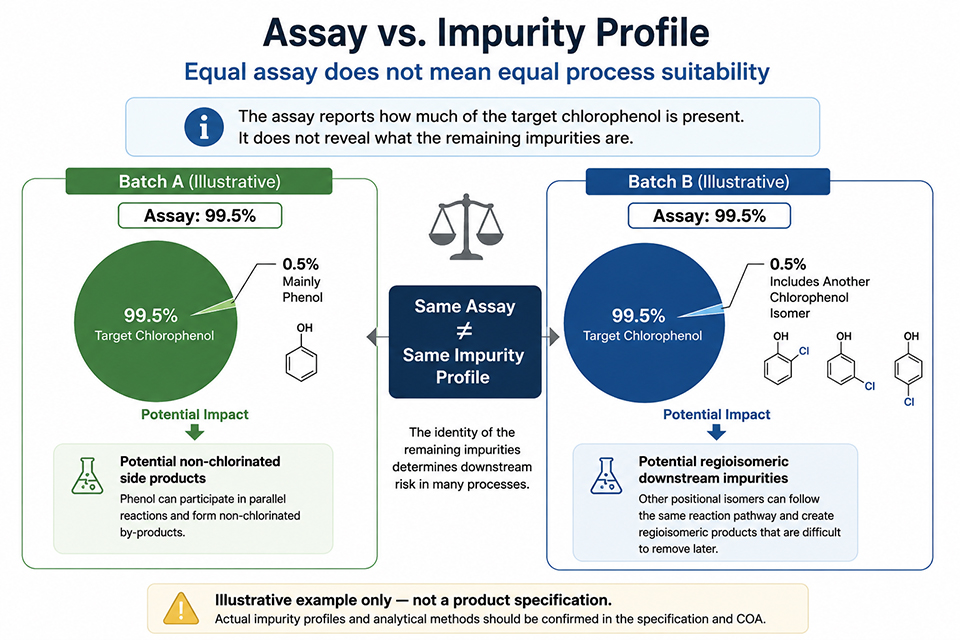
Illustrative example only — not a product specification.
Batch A: 99.5% assay; the remaining impurity is predominantly phenol.
Batch B: 99.5% assay; the remaining impurity includes another chlorophenol positional isomer.
On a purchasing spreadsheet, the two lots may initially appear equivalent. In a route that must preserve a single substitution pattern, however, they may not be equally suitable. Batch A can potentially generate non-chlorinated downstream derivatives from residual phenol. Batch B may generate a second regioisomeric chlorinated product family from the wrong starting isomer. Depending on the downstream chemistry, that regioisomeric impurity may become difficult to distinguish or remove after subsequent steps.
For applications where these differences matter, request positional-isomer information, relevant phenol data, moisture information and an appropriate analytical method rather than relying only on a headline assay. The percentages above are conceptual examples and are not Aure Chemical product specifications.
Step 4 — Review Batch Consistency and Scale-Up Requirements
A material that performs satisfactorily at R&D scale should remain sufficiently consistent when the project moves to commercial production. Sample approval is an important technical step, but it does not replace an agreed commercial specification.
Critical parameters that may matter between an evaluation sample and later commercial lots include positional-isomer profile, residual phenol, moisture, appearance, physical form and the analytical method used for release testing. For temperature-sensitive materials such as 3-Chlorophenol, sampling conditions should also be appropriate to the physical state of the lot. Representative sampling and consistent analytical procedures become increasingly important when moving from R&D evaluation to commercial supply.
Before scale-up, define the parameters that are genuinely critical to the process: correct isomer identity, assay, other monochlorophenol isomers, residual phenol, moisture where relevant, and any appearance requirement used by the process or receiving quality system. The practical objective is for future commercial supply to remain within the agreed critical quality limits rather than assuming that every lot will be identical to the original evaluation sample.
Step 5 — Evaluate Packaging and Handling Requirements
Packaging should match the isomer, physical form, quantity, transport classification, storage conditions and the buyer’s receiving and handling system. It should not be treated as a one-size-fits-all catalog decision.
A liquid 2-Chlorophenol package must be compatible with liquid containment, closure integrity and transfer requirements. A low-melting 3-Chlorophenol package may need to accommodate changes in physical state during transit or storage. A solid 4-Chlorophenol package should support the receiving site's solid-handling or controlled-melting process where applicable. The same destination climate can therefore create different receiving considerations for the three isomers.
Quantity, destination and transportation mode may also influence the appropriate packaging arrangement. Export shipments add classification, labeling and documentation requirements according to the product and mode of transport. Current packaging options should be confirmed for the specific isomer, quantity and destination. A packaging configuration used for one order should not automatically be assumed to apply to all three chlorophenols or to future shipments.
Step 6 — Confirm Documents Before Ordering
Documents convert a commercial description into a material that purchasing, receiving, EHS and quality teams can evaluate and accept. The required document set depends on the product, destination and transaction, and not every shipment automatically requires every document listed below.
| Document / Information | Why Buyers May Need It |
|---|---|
| Specification | Defines the required or agreed quality parameters |
| Current / representative COA | Provides analytical results for a representative or specific batch |
| SDS | Provides safety, handling and transportation information |
| TDS if available | Provides additional product or technical information |
| Analytical method | Important where positional-isomer or impurity differentiation matters |
| Packaging information | Supports receiving, storage and process planning |
| Commercial invoice | Required for international trade and customs documentation |
| Packing list | Identifies shipment contents and packaging configuration |
| DG documentation where applicable | Supports compliant dangerous-goods transportation where required |
| Certificate of Origin where required | May support customs, tariff or trade requirements |
For industrial chlorophenol evaluation, the specification, current or representative COA, SDS and relevant analytical information are often among the first items to review. Packing lists, invoices, dangerous-goods documentation and Certificates of Origin depend on the product, destination and transaction requirements. Buyers should identify mandatory receiving or customs documents early in the sourcing process.
Step 7 — Evaluate the Supplier, Not Only the Price
Price should normally be compared after technical suitability has been established. Industrial chlorophenol sourcing is a specification, documentation and supply-coordination decision as well as a unit-price comparison.
A capable chlorophenol supplier should understand why the exact CAS number matters, be able to discuss relevant impurity requirements rather than relying only on a generic purity statement, provide representative or current analytical documentation, communicate clearly about packaging and export requirements, and coordinate technical questions when the application requires additional review. Traceability, batch consistency, documentation quality and sample coordination where feasible are also relevant supplier-evaluation factors.
Aure Chemical is a China-based chemical supplier, exporter and sourcing partner. It is not the manufacturer of the chlorophenols discussed on this page. For a defined isomer inquiry, Aure Chemical can help coordinate technical specification communication, sourcing, COA review, sample coordination where feasible, packaging confirmation, export documentation and shipping arrangements. Current specifications, packaging and commercial availability should be confirmed for the specific isomer, quantity and destination.
If the required isomer is already known, use the corresponding product page and request a quotation against that exact CAS number rather than submitting a generic “chlorophenol” inquiry.
Chlorophenol Selection Decision Table
Use this decision table after the required downstream architecture has been identified. “Evaluate” means that the listed direction is technically relevant to review; it does not mean that one commercial grade is automatically suitable for every process.
| If Your Requirement Is... | Selection Direction |
|---|---|
| Target requires adjacent OH/Cl positions | Evaluate 2-Chlorophenol (o-Chlorophenol, CAS 95-57-8) |
| Target requires a 1,3 relationship | Evaluate 3-Chlorophenol (m-Chlorophenol, CAS 108-43-0) |
| Target requires a 1,4 relationship | Evaluate 4-Chlorophenol (p-Chlorophenol, CAS 106-48-9) |
| Liquid handling preferred | Consider physical form only after regiochemistry is fixed |
| Low-melting behavior may affect warehouse handling | Review 3-Chlorophenol storage and handling temperatures |
| Strict regiochemical purity required | Request positional-isomer data and confirm analytical method suitability |
| Moisture-sensitive synthesis | Define a relevant moisture requirement |
| Commercial repeat supply | Review critical batch-consistency parameters and analytical methods |
| Export shipment | Confirm packaging, SDS and applicable transport documentation |
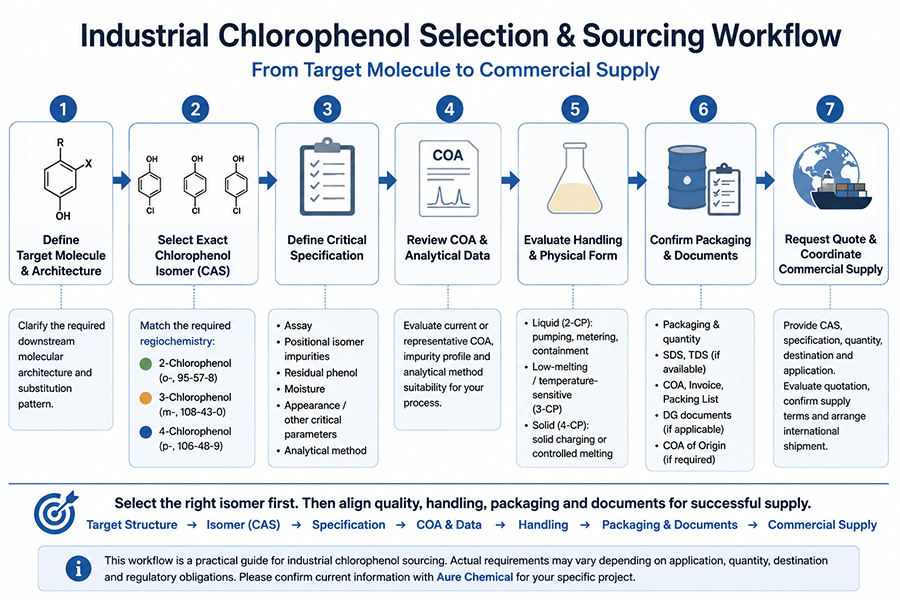
Common Selection Mistakes
Common chlorophenol procurement errors often begin with incomplete isomer, specification or application information rather than with the quoted price itself.
Choosing by Price Before Regiochemistry
The wrong isomer is the wrong starting molecule for a route that depends on a defined substitution pattern. A lower-priced 4-Chlorophenol lot cannot create a 1,2-substituted intermediate when the process requires an ortho architecture. Commercial quotations should therefore be compared only after the required CAS number has been established.
Comparing Only Headline Purity
Two high-assay lots can contain different remaining components. Residual phenol, another monochlorophenol isomer, moisture and other related impurities do not present identical process risks. Buyers should understand what the assay represents and which impurities are relevant before assuming that the higher headline number automatically indicates the more suitable grade.
Ignoring Positional-Isomer Content
Another monochlorophenol isomer may participate in similar downstream transformations and generate a regioisomeric product that can become difficult to distinguish or remove later in the synthesis. If the downstream route is sensitive to this type of contamination, positional-isomer information should be included in the RFQ or technical specification discussion.
Treating Physical Form as a Quality Ranking
Liquid is not automatically better than solid. 2-Chlorophenol is typically liquid near ambient temperature because of its melting behavior, not because it represents a superior quality grade. Physical form affects pumps, charging systems, warehouse conditions and transfer procedures. It does not override regiochemistry.
Assuming an R&D Sample Guarantees Every Future Lot
A successful sample evaluation demonstrates that the tested material was suitable under the conditions used. Commercial supply still requires appropriate specification alignment, comparable analytical control and attention to the parameters that are critical to process reproducibility.
Requesting “Chlorophenol” Without a CAS Number
A generic chlorophenol inquiry does not identify which of the three positional isomers is required. Wherever possible, specify CAS 95-57-8, 108-43-0 or 106-48-9. If the downstream architecture has not yet been decided, request technical selection support before asking for a final commercial quotation.
What Information Should You Send When Requesting a Chlorophenol Quote?
A complete inquiry helps a chlorophenol supplier evaluate the correct isomer, specification discussion and logistics solution instead of responding with a generic catalog offer. Include as much of the following information as is available:
Target isomer and CAS number
Required assay or specification
Critical impurity limits, particularly other chlorophenol isomers or residual phenol where relevant
Moisture requirement if applicable
Intended application or general downstream chemistry
Whether a sample is required for evaluation
Initial order quantity and expected annual requirement
Destination country or port
Preferred Incoterm if known
Packaging preference or receiving constraints
Required documentation such as COA, SDS, transport documents or Certificate of Origin where applicable
If some technical parameters are still open, providing the CAS number, quantity, destination and intended application is a useful starting point. The specification can then be refined after available documentation and analytical data are reviewed. A clear RFQ reduces the risk of receiving a quotation for the wrong isomer, unsuitable impurity profile or impractical logistics arrangement.
Frequently Asked Questions About Chlorophenol Selection
What is the main difference between 2-, 3- and 4-Chlorophenol?
They are positional isomers of C6H5ClO. The chlorine is located ortho, meta or para to the phenolic OH, creating a 1,2, 1,3 or 1,4 substitution pattern. This determines the molecular architecture carried into downstream derivatives and also contributes to differences in melting behavior and handling form.
Which chlorophenol isomer should I choose?
Choose the isomer that already contains the substitution pattern required by the target molecule. Evaluate 2-Chlorophenol for a 1,2 / ortho relationship, 3-Chlorophenol for a 1,3 / meta relationship and 4-Chlorophenol for a 1,4 / para relationship. Once the molecular architecture is fixed, define quality, handling, packaging and documentation requirements.
Is 2-Chlorophenol better because it is liquid?
No. Physical form does not override regiochemistry. 2-Chlorophenol is typically liquid near ordinary ambient temperatures because of its low melting point. Liquid handling may be convenient in some processes, but it is still the wrong starting material if the downstream target requires a meta or para substitution pattern.
Are 2-, 3- and 4-Chlorophenol interchangeable?
No, where downstream molecular architecture matters. A high-assay para isomer cannot replace an ortho isomer in a route requiring a 1,2 relationship. The three CAS numbers represent distinct starting materials with different substitution patterns.
Is purity the most important specification for chlorophenol?
Assay is important but is not sufficient by itself. The identity of the remaining impurities — particularly another positional isomer, residual phenol or moisture where relevant — may matter more to the downstream process than a small difference in headline assay. Review both the impurity profile and the analytical method used.
Why should I check positional-isomer impurities?
An unwanted monochlorophenol isomer may undergo similar downstream chemistry and generate a regioisomeric impurity. These regioisomeric products may have physicochemical properties similar to the desired material and can become increasingly difficult to remove later in a multi-step synthesis. Where regiochemical purity matters, controlling the starting-material isomer profile can therefore be important.
Why can 3-Chlorophenol physical form vary during storage?
3-Chlorophenol has a melting range close to common warehouse and plant temperatures. Depending on storage and transit conditions, the same material may therefore appear as a solid, a partially melted mass or a liquid. Sampling and handling procedures should take this temperature-sensitive behavior into account rather than treating appearance alone as evidence of a quality difference.
What documents should I request from a chlorophenol supplier?
Start with the applicable specification, a current or representative COA, the SDS and relevant analytical information. Depending on the product, destination and transaction, additional requirements may include packaging information, commercial invoice, packing list, dangerous-goods documentation and Certificate of Origin.
Can Aure Chemical provide a sample before commercial ordering?
Sample coordination may be discussed where feasible, depending on the product and project requirements. A sample should be evaluated against the intended technical requirements, while future commercial supply should be governed by the agreed critical specification rather than assumed to be identical in every non-critical characteristic.
Request a Quote for the Correct Chlorophenol Isomer
If the required molecular architecture is known, request a quotation against the exact CAS number rather than a generic chlorophenol description. Aure Chemical can discuss current specification information, representative or current COA availability, sample coordination where feasible, packaging requirements, commercial quotation and export shipment arrangements as a China-based chemical supplier, exporter and sourcing partner.
For a more efficient evaluation, provide the CAS number, specification requirements, quantity, destination and intended application where available. Then continue to the matching product page:
Request 2-Chlorophenol Quote — 2-Chlorophenol (o-Chlorophenol, CAS 95-57-8)
Request 3-Chlorophenol Quote — 3-Chlorophenol (m-Chlorophenol, CAS 108-43-0)
Request 4-Chlorophenol Quote — 4-Chlorophenol (p-Chlorophenol, CAS 106-48-9)