

Chlorophenols in Pharmaceutical and Fine Chemical Synthesis
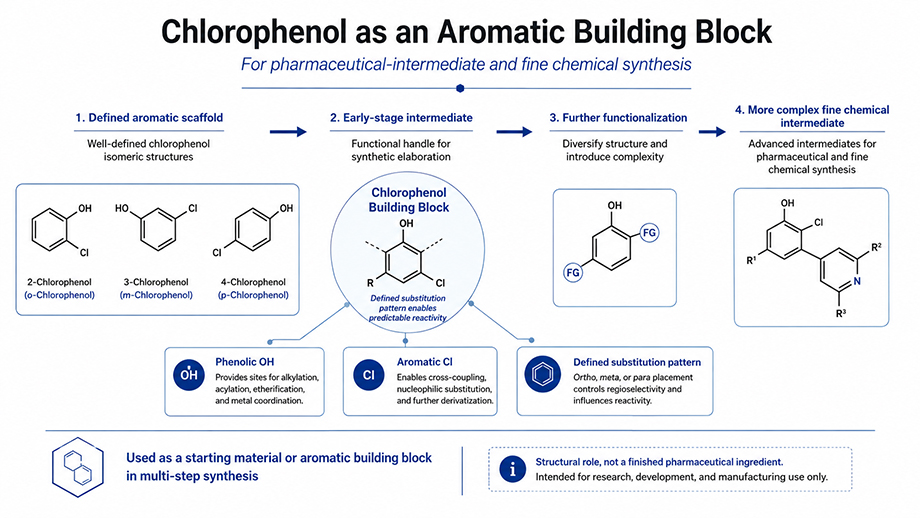
Monochlorophenols can serve as substituted aromatic building blocks in multi-step pharmaceutical-intermediate and fine chemical synthesis. Their value is structural, not regulatory: each isomer already contains a phenolic hydroxyl group, an aromatic chlorine substituent and a fixed ortho, meta or para relationship. Routes that depend on precise regiochemistry therefore need the correct CAS number before they need a generic purity label. Correct isomer identity and impurity control can matter from the first downstream step because the starting substitution pattern may be carried into increasingly complex intermediates.
2-Chlorophenol, 3-Chlorophenol and 4-Chlorophenol share the formula C6H5ClO, but they are different starting structures. A small amount of the wrong positional isomer may undergo similar downstream chemistry and generate a regioisomeric impurity that becomes more difficult to manage after additional steps. Technical suitability depends on the customer’s synthesis route, specification and documentation requirements — not on a generic “pharmaceutical use” description. For chemical identity and a broader comparison, see the overview of 2-, 3- and 4-Chlorophenol isomers.
Why Chlorophenols Are Useful in Pharmaceutical and Fine Chemical Synthesis
Chlorophenols provide a defined chlorinated aromatic scaffold together with a phenolic functional group, allowing chemists to introduce a known substitution pattern early in a multi-step synthesis. That structural certainty is the main reason they may be selected as starting materials or intermediates in fine chemical campaigns and in routes that later produce pharmaceutical intermediates.
A process chemist may prefer to begin with an aromatic building block that already contains the required oxygen functionality and chlorine position rather than establish both features after additional substituents have been introduced. Starting with a monochlorophenol fixes a 1,2, 1,3 or 1,4 relationship at the beginning of the sequence. Downstream oxygen-functionalized derivatives can retain that relationship, while later ring chemistry is built on the same substitution map. This also creates a clearer impurity-control strategy because the desired isomer and any unwanted positional isomer can be evaluated at the raw-material stage.
This is an aromatic building-block role. It does not make chlorophenol an API, a finished dosage-form ingredient or a “pharmaceutical-grade” raw material by default. Suitability depends on the customer’s synthesis route and qualification requirements. For deeper discussion of oxygen functionalization, ring chemistry and route-dependent aryl-chloride reactivity, see chlorophenols as building blocks in organic synthesis. This page focuses on route selection, impurity control and material qualification.
Why the Correct Chlorophenol Isomer Matters
The wrong positional isomer is not a lower-quality version of the correct one. It is a different starting structure. In pharmaceutical-intermediate and fine chemical routes, that difference can be carried into later intermediates and create a separate regioisomeric product family.
| Isomer | Defined Starting Architecture | Why It Can Matter in Multi-Step Synthesis |
|---|---|---|
| 2-Chlorophenol (o-Chlorophenol, CAS 95-57-8) | 1,2 / Ortho | Provides adjacent OH/Cl substitution for downstream structures requiring an ortho relationship |
| 3-Chlorophenol (m-Chlorophenol, CAS 108-43-0) | 1,3 / Meta | Provides a defined meta scaffold for downstream structures requiring a 1,3 relationship |
| 4-Chlorophenol (p-Chlorophenol, CAS 106-48-9) | 1,4 / Para | Provides a para aromatic framework for downstream structures requiring a 1,4 relationship |
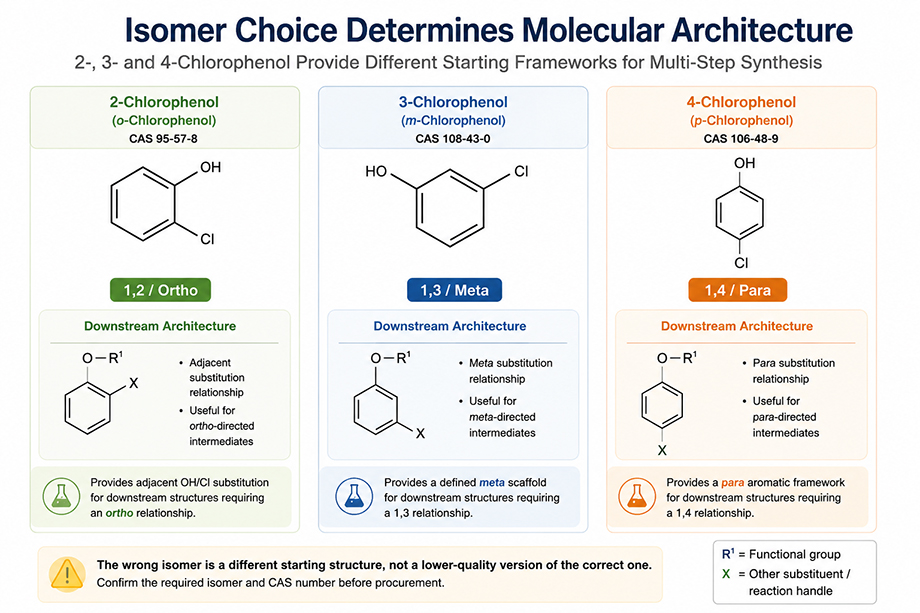
2-Chlorophenol is appropriate when the target intermediate requires oxygen and chlorine on adjacent aromatic carbons. 3-Chlorophenol provides a defined 1,3 relationship that cannot be obtained by simply substituting the ortho or para isomer. 4-Chlorophenol provides a 1,4 framework. These distinctions describe molecular architecture; they do not rank generic reactivity or imply that one isomer is universally more useful in pharmaceutical-intermediate synthesis.
If the required architecture has not yet been fixed, route design should come before purchasing. If the correct architecture is already known and the remaining questions concern quality, physical form, documentation or procurement, see how to choose between 2-, 3- and 4-Chlorophenol.
Purity Is More Than a Headline Assay
A high assay alone does not define whether a chlorophenol is suitable for a demanding pharmaceutical-intermediate or fine chemical route. Assay indicates how much of the named isomer is present, but it does not necessarily identify the remaining components. In many multi-step synthesis projects, the identity of those remaining impurities can be as important as the headline purity number.
Assay is the baseline purity measurement. It is important in a technical RFQ, but it is not sufficient when downstream chemistry can transform an impurity into a larger related molecule. Two lots with similar assay can differ in positional-isomer content, residual phenol, moisture or other related organic impurities.
Positional-isomer impurities deserve particular attention. Another monochlorophenol isomer may participate in similar oxygen-functionalization or ring chemistry and generate a regioisomeric downstream impurity. It may not behave identically in every reaction and may not survive every step. When it does survive subsequent transformations, however, the resulting regioisomeric impurity may become more difficult to distinguish analytically or remove from the desired intermediate. Controlling the unwanted isomer at the starting-material stage can therefore be an efficient control strategy.
Residual phenol presents a different impurity pathway because phenol lacks the chlorine substituent. Depending on the downstream route, it may participate in parallel chemistry, generate non-chlorinated derivatives, consume reagent or increase purification requirements. There is no universal acceptable phenol limit; where it matters, the requirement should be defined according to the intended process.
Moisture may matter depending on route sensitivity, reagents, catalyst systems and oxygen-functionalization steps. It is not universally critical for every chlorophenol application. Where water-sensitive chemistry is involved, moisture should be treated as a defined material attribute rather than inferred from appearance.
Other related organic impurities or unidentified analytical peaks may also become relevant as a project moves from feasibility work toward a qualified commercial process. The practical question is not simply “What is the purity?” but “Which impurities are present, how are they measured, and do they matter to this route?”
Why Positional-Isomer Control Can Matter More as the Molecule Becomes More Complex
A small positional-isomer impurity in the starting chlorophenol can become a structurally similar impurity in a larger downstream intermediate. Early control is often preferable because analytical differentiation and purification may become more challenging as the synthesis progresses.
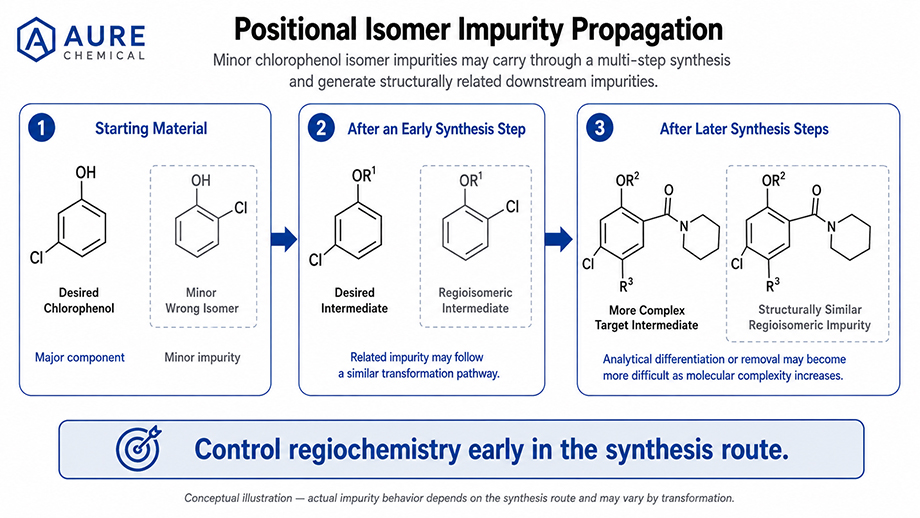
At the raw-material stage, the distinction may simply be the target monochlorophenol versus another monochlorophenol positional isomer. After the first transformation, the process may contain the desired intermediate plus a corresponding regioisomeric intermediate. After additional reaction steps, that impurity can develop into a more complex analogue of the intended product series.
The impurity will not necessarily survive every transformation, and later removal is not always impossible. However, managing a regioisomeric impurity after several synthesis steps may require additional analytical or purification development compared with controlling the unwanted positional isomer at the starting-material stage.
This is why pharmaceutical-intermediate and fine chemical projects may treat positional-isomer content as a critical material attribute rather than as a minor note beneath a single assay number. Controlling regiochemistry early can reduce downstream uncertainty in analytical development and purification.
Analytical Information for Pharmaceutical and Fine Chemical Projects
The important question is whether the analytical method can adequately separate and quantify the components that are critical to the customer’s process. The technique name — GC, HPLC or another appropriate method — matters less than whether the method is fit for the required impurity-control purpose.
| Analytical / Quality Item | Why It May Matter |
|---|---|
| Assay | Confirms the level of the target chlorophenol isomer |
| Positional-isomer profile | Supports control of unwanted ortho, meta or para isomers |
| Residual phenol | Identifies a potential non-chlorinated precursor impurity |
| Moisture | May be relevant to water-sensitive processing |
| Related organic impurities | Helps define the overall impurity fingerprint |
| Analytical method | Determines whether critical components are adequately separated and quantified |
| Batch identification | Supports lot traceability and technical review |
| Appearance | Provides a useful supporting receiving observation |
A COA that reports only a headline purity may leave the process chemist without enough information to understand whether another chlorophenol isomer is included in the remainder. Similarly, a method that does not adequately resolve the relevant positional isomers cannot support a tight isomer specification simply because the assay is reported to several decimal places. Appearance remains useful as a receiving observation, but it should not replace analytical data.
Buyers should review the method used for the representative or current COA and compare it with the attributes that actually affect the route. Current specifications and available analytical detail should be confirmed for the specific isomer and project. Literature values and generic catalog grades should not be treated as customer-qualified specifications.
From R&D Route Development to Commercial Scale
Qualification should evolve with project scale. An R&D sample that demonstrates route feasibility does not automatically define the final commercial specification.
A typical evaluation pathway may include identifying the required CAS and positional isomer, defining critical material attributes, reviewing a representative specification and COA, evaluating a sample where appropriate, confirming that the analytical method can measure the required attributes, establishing commercial acceptance criteria and then moving into repeat supply.
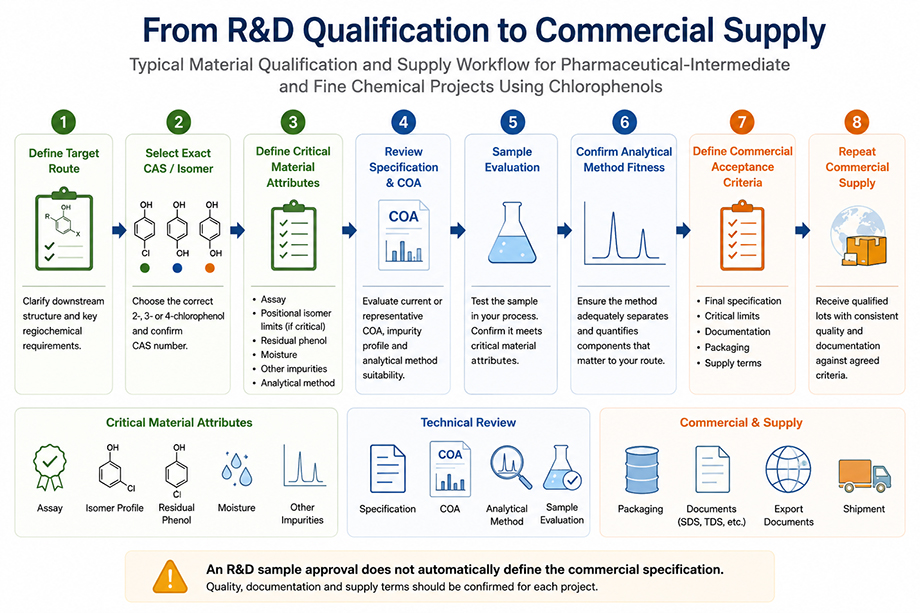
Scale-up can make impurity profile, moisture, representative sampling, physical handling and batch consistency more important than they were during early feasibility work. Physical form and temperature-dependent handling should be addressed after the correct isomer has been selected. For a detailed comparison of these considerations, see the chlorophenol isomer selection guide.
This is a material-qualification pathway. It should not be interpreted as a GMP manufacturing process, API release procedure or pharmaceutical regulatory filing package.
Batch Consistency and Change Control Considerations
Repeat fine chemical and pharmaceutical-intermediate projects may require more than a one-time assay match. The practical objective is for future commercial lots to remain within the critical material attributes established during qualification.
Consistency discussions may include assay, positional-isomer profile, residual phenol, moisture, analytical methodology and appearance where relevant. Buyers may also want to understand whether future lots will be evaluated against the same critical quality criteria used during sample or initial commercial qualification.
Changes in analytical methodology can affect how impurities are detected, resolved and reported, so method consistency — or appropriate comparison between methods — may matter in qualified supply programs. Where the project requires formal supplier qualification, source-change notification or other change-management expectations, those requirements should be discussed before commercial supply.
A standard chemical supply transaction should not automatically be assumed to include pharmaceutical change-control procedures. Any required notification relating to source, analytical method, specification or another critical supply parameter should be defined explicitly between the parties.
Documentation Buyers May Request
Documentation should match the project, destination and transaction requirements. Availability should be confirmed case by case. A pharmaceutical-intermediate application does not automatically mean that a regulatory dossier or pharmaceutical certification package exists for the chlorophenol being sourced.
| Document / Information | Typical Purpose |
|---|---|
| Product specification | Defines target quality parameters |
| Representative / current COA | Shows available analytical results for technical review |
| SDS | Provides safety and handling information |
| TDS if available | Provides additional technical product information |
| Analytical method information | Helps assess whether critical impurities can be differentiated |
| Batch / lot identification | Supports traceability |
| Packaging information | Supports receiving, storage and handling planning |
| Commercial / export documents | Supports international shipment and customs processes |
| Regulatory declarations if specifically required and available | May support customer qualification requirements |
Specification, COA, SDS and relevant analytical information are common starting points for a technical review. Export documents follow the requirements of the shipment. Regulatory declarations, where required, should be identified specifically by the buyer and confirmed as available for the relevant supply path.
This page should not be interpreted as evidence that GMP certificates, Drug Master Files (DMF), Certificates of Suitability (CEP), FDA registrations, ICH documentation packages or other pharmaceutical regulatory documents exist for these chlorophenols. Any such requirement must be verified separately for the specific material and supply chain.
Pharmaceutical Intermediate Use vs. “Pharmaceutical Grade”
A chemical being used as a starting material or building block in pharmaceutical-intermediate synthesis does not automatically make that chemical “pharmaceutical grade.” Application and product grade are different questions.
Application describes where the molecule is used in a synthesis route. A chlorophenol may serve as a starting material or early aromatic building block in a multi-step sequence that later produces a pharmaceutical intermediate or another fine chemical. That is a description of use.
Product grade and regulatory status are defined by the agreed specification, the controls supporting the material, the documentation package, the customer’s qualification process and any applicable regulatory requirements. None of these attributes is created simply by describing the application as “pharmaceutical synthesis.”
Buyers should therefore specify the actual technical and documentation requirements they need: CAS number, assay, positional-isomer expectations where critical, residual phenol limits where critical, moisture requirements where relevant, analytical information, COA, SDS and any supplier-qualification documents required by their quality system.
A request for “pharma grade chlorophenol” without defined quality and documentation requirements may create ambiguity. A more effective approach is to define the critical material attributes and qualification requirements that the intended route actually needs.
What Pharmaceutical and Fine Chemical Buyers Should Include in an RFQ
An exact CAS number and clear impurity requirements are more useful than an inquiry that simply states “chlorophenol for pharmaceutical use.” A technically complete inquiry reduces the risk of quoting the wrong positional isomer or discussing a grade that does not match the intended route.
Exact chlorophenol isomer and CAS number
Required assay or specification
Positional-isomer limits if critical
Residual phenol requirement if critical
Moisture requirement if applicable
Intended application or general downstream route
Whether a sample is requested for evaluation
Initial quantity and expected commercial or annual quantity
Destination country or port
Packaging requirement if the receiving site has specific constraints
Required technical and export documentation
Special supplier-qualification or notification requirements, if applicable
If some technical parameters are still under development, the CAS number, quantity, destination and general application are useful starting points. Impurity requirements can then be refined after available specifications and COA data are reviewed. The supplier can evaluate and source a defined chemical isomer; it cannot reliably infer the required 1,2, 1,3 or 1,4 architecture from the word “pharmaceutical” alone.
Frequently Asked Questions About Chlorophenol Pharmaceutical Intermediates
Why are chlorophenols used in pharmaceutical-intermediate or fine chemical synthesis?
Chlorophenols combine a phenolic oxygen functionality with a chlorinated aromatic ring and a defined substitution pattern. This allows a multi-step synthesis route to begin with a known 1,2, 1,3 or 1,4 aromatic scaffold. Use in such a route does not make the chlorophenol itself an API or finished pharmaceutical ingredient.
Are 2-, 3- and 4-Chlorophenol interchangeable?
No, where downstream molecular architecture matters. The three compounds are different positional isomers and therefore different starting structures. A high assay on the wrong CAS number does not compensate for an incorrect substitution pattern.
Which chlorophenol isomer should be used for pharmaceutical-intermediate synthesis?
The correct isomer depends on the downstream molecular structure required by the synthesis route. 2-Chlorophenol provides a 1,2 / ortho relationship, 3-Chlorophenol provides a 1,3 / meta relationship and 4-Chlorophenol provides a 1,4 / para relationship. For a detailed procurement comparison, see how to choose between 2-, 3- and 4-Chlorophenol.
Does pharmaceutical-intermediate use mean the chlorophenol is pharmaceutical grade?
No. Application describes how the chemical is used in a synthesis route. Product grade and regulatory status depend on specification, material controls, documentation and the customer’s qualification requirements. Buyers should define those requirements directly rather than relying on an undefined “pharma grade” description.
Why do positional-isomer impurities matter?
Another monochlorophenol positional isomer may undergo similar downstream chemistry and generate a regioisomeric impurity. If that impurity survives subsequent steps, it may become more difficult to distinguish analytically or remove as molecular complexity increases. Where regiochemistry is critical, controlling the starting-material isomer profile can therefore be important.
Is 99% or 99.5% purity enough for pharmaceutical-intermediate synthesis?
There is no universal assay level that automatically makes a chlorophenol suitable for every pharmaceutical-intermediate route. Two lots with similar assay may differ substantially in suitability if one contains a higher level of a critical positional-isomer impurity or another process-relevant component. Suitability depends on the complete specification, impurity profile, analytical method and intended synthesis.
What analytical data should buyers review?
Depending on the route, buyers may review assay, positional-isomer profile, residual phenol, moisture, related organic impurities, batch identity and the analytical method used to generate the COA. The method should be capable of separating and quantifying the components that are critical to the customer’s process.
Can Aure Chemical provide COA and technical documentation?
Aure Chemical can coordinate available product specifications, representative or current COA, SDS and other technical documentation according to the project. Availability of additional declarations or qualification documents should be confirmed case by case. Aure Chemical acts as a China-based chemical supplier, exporter and sourcing partner rather than as the manufacturer of these chlorophenols.
Can a sample be evaluated before commercial purchase?
Sample coordination may be discussed where feasible, depending on the product and project requirements. A sample can support route or material evaluation, but future commercial supply should ultimately be assessed against the agreed critical quality requirements rather than assumed to be identical in every characteristic to the original evaluation sample.
Discuss Your Chlorophenol Requirement
If your project uses a chlorophenol as a starting material or aromatic building block in pharmaceutical-intermediate or fine chemical synthesis, provide the exact isomer or CAS number, target specification, critical impurity limits, intended application, quantity, destination and required documentation. These details allow a more technically relevant supply evaluation than a generic catalog inquiry.
Aure Chemical can help coordinate suitable supply options, technical specification discussion, representative or current COA review, sample coordination where feasible, documentation, commercial quotation and international shipment as a China-based chemical supplier, exporter and sourcing partner. Current specifications, packaging and commercial availability should be confirmed for the specific isomer and project.