
Handling: Avoid ingestion, dust inhalation and skin or eye contact. Use suitable ventilation and select protective gloves, clothing and eye protection according to the current supplied-grade SDS and workplace exposure assessment. Confirm the complete hazard classification and labeling for the supplied material before use.
Storage: Keep containers tightly closed and protect this hygroscopic solid from moisture. Follow the current SDS for storage conditions, compatible containers, incompatible materials and any inert-gas requirements.
Shipping: Confirm transport classification and packaging requirements against the current supplied-grade SDS and the applicable transport-mode and destination requirements before dispatch.
Documentation: Request the applicable SDS and batch-specific COA before ordering. This page provides procurement reference information and does not replace the SDS, an analytical-method qualification or a process safety assessment.
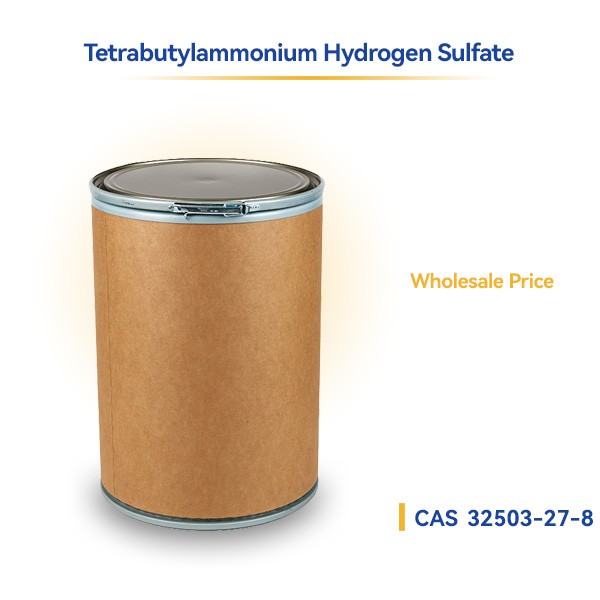
Tetrabutylammonium Hydrogen Sulfate CAS 32503-27-8 TBAHS / TBAS
Tetrabutylammonium Hydrogen Sulfate CAS 32503-27-8 from Aure Chemical
Tetrabutylammonium hydrogen sulfate (TBAHS), also known as tetrabutylammonium bisulfate and sometimes abbreviated TBAS, CAS 32503-27-8, is a quaternary ammonium salt consisting of a tetrabutylammonium cation and a hydrogen sulfate anion. It is used as a phase-transfer catalyst in selected organic syntheses and, in appropriately qualified grades, as an ion-pairing reagent in chromatography. Aure Chemical supports China sourcing and export supply, including specification review, quality documentation and supplier coordination for the intended application.
The lipophilic tetrabutylammonium cation can help bring reactive anions into contact with organic substrates in multiphase systems. The hydrogen sulfate anion also contributes acidity, so solvent composition, base balance and reaction conditions affect suitability. The reference analysis below describes a crystalline ≥99% assay grade.
Basic Information of Tetrabutylammonium Hydrogen Sulfate
Identity and general reference properties are listed below. These are distinct from the reported acceptance limits and single-lot analytical results in the Reference Quality Analysis section.
| CAS No.: | 32503-27-8 |
|---|---|
| EC No.: | 251-068-5 |
| Molecular Formula: | C₁₆H₃₇NO₄S |
| Ionic Formula: | [(n-C₄H₉)₄N]⁺ HSO₄⁻ |
| Molecular Weight: | 339.53 g/mol |
| Appearance: | White to off-white crystals (reported grade specification) |
| Melting Point: | Approximately 173 °C (reference value; not a reported batch result) |
| Solubility: | Soluble in water. Confirm organic-solvent compatibility at the concentration required for the intended process. |
| Moisture Sensitivity: | Hygroscopic; protect from moisture and follow the current supplied-grade SDS for storage requirements. |
| Reference Grade Assay: | ≥99% (reported specification; reference batch result shown below) |
| Chemical Structure: | 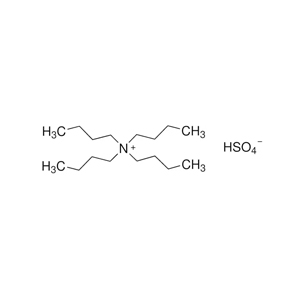 |
The reference product is a crystalline solid. Suitability as a catalyst, chromatographic reagent or electrolyte additive depends on the complete purchasing specification and the process conditions.
Reference Quality Analysis
The following quality parameters provide a technical reference for evaluating the ≥99% assay tetrabutylammonium hydrogen sulfate grade, including crystalline appearance, assay and loss on drying. The reported acceptance limits are shown separately from the corresponding results for one production lot.
| Test Item | Reported Specification | Reference Result |
|---|---|---|
| Appearance | White to off-white crystals | White crystals |
| Assay (%) | ≥99% | 99.54% |
| Loss on Drying (%) | ≤1.0% | 0.18% |
Loss on drying is reported as a separate test from assay. It measures mass loss under the test conditions and should not be treated as a water-specific measurement. The COA does not state the drying temperature, drying duration, assay method or whether assay is reported on an as-received or dried basis.
The COA does not provide limits or results for individual ionic impurities, trace metals, UV absorbance or other chromatographic qualification parameters. Requirements for these properties should be specified separately where relevant to the intended synthesis or analytical method.
These analytical values are provided for preliminary technical evaluation and should not be interpreted as guaranteed results for every shipment. Please contact Aure Chemical to confirm the applicable quality requirements and request the relevant batch-specific Certificate of Analysis (COA) before ordering.
Primary Applications of Tetrabutylammonium Hydrogen Sulfate (TBAHS)
TBAHS applications involve ion pairing, phase transfer or the behavior of its hydrogen sulfate-containing reaction medium. Its effect on reaction rate, selectivity or analytical performance must be established in the specific system.
Phase-Transfer Catalyst in Organic Synthesis: Used in selected reactions between substrates and ionic reagents present in different phases. The tetrabutylammonium cation can associate with reactive anions and assist their transfer or contact with an organic substrate. Performance depends on anion exchange, solvent system, mixing, base conditions and substrate selection; improved yield or selectivity requires process-specific validation.
Electrochemical Additive Research: Investigated as an electrolyte additive in aqueous sulfuric acid systems, including lead-acid battery research. The hydrogen sulfate acidity, water content, electrode compatibility and electrochemical operating window require evaluation. The reference assay and loss-on-drying results do not establish suitability as an electrochemical-grade supporting electrolyte.
Polymer and Reaction-Medium Research: Reported as a cocatalyst or component of wet ionic reaction media in selected carbon monoxide/ethylene transformations producing alternating polyketones and propionic acid. These are specific catalytic systems; application depends on the metal complex, water content and reaction conditions. General polymer-initiator or nanomaterial performance is not established by the reference COA.
Ion-Pairing Reagent in Chromatography: Appropriately qualified TBAHS grades are used in ion-pair liquid chromatography to alter the retention and separation of ionic analytes. Method suitability depends on mobile-phase composition, pH, detector compatibility and impurity requirements. A ≥99% assay result alone does not establish HPLC or ion-pair chromatography grade; any required absorbance or other qualification tests should be agreed separately.
Aure Chemical: TBAHS Sourcing and Export Support
Aure Chemical is a chemical trading and export supply company supporting tetrabutylammonium hydrogen sulfate purchases from China through specification review, supplier coordination, quality documentation and international export logistics.
Specification Review: Review assay, loss on drying and appearance against available documentation. Additional requirements for ionic impurities, metals or analytical qualification should be stated before ordering.
Quality Documentation: Confirm availability of the applicable technical specification, current supplied-grade SDS and relevant batch-specific COA. Acceptance limits are kept separate from individual batch results.
Supplier Coordination: Confirm grade availability, quantity, packaging and lead time for each inquiry. Any additional testing or inspection arrangements are reviewed with the supplier before an order is agreed.
Export Logistics: Coordinate packaging, shipping documentation and transport arrangements according to the current SDS, order quantity, transport mode and destination requirements.
Application Requirements: Communicate any requirements for particle size, water-specific testing or other unreported properties to the supplier. Availability and acceptance criteria are confirmed for the proposed supply.
Please provide the required quantity, destination and purchasing specification so that Aure Chemical can review the available supply options and supporting documentation.
Safety, Handling & Documentation
Packaging
10kg, 20kg Fiber drum
Final packaging, capacity and net weight are confirmed in the quotation and order.