

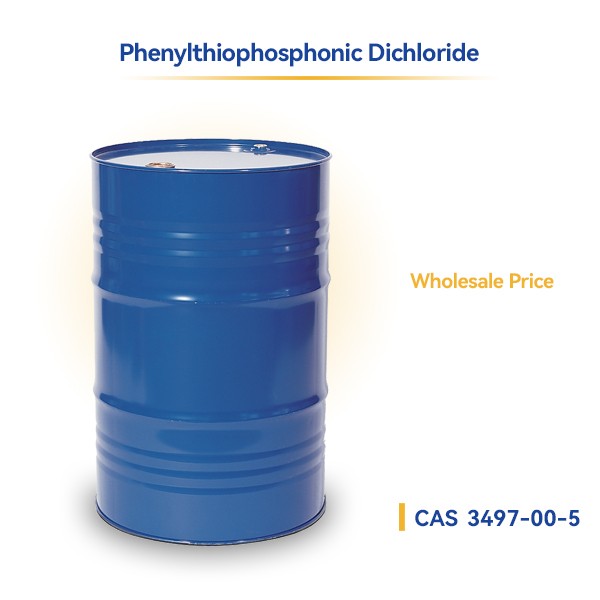
Phenylthiophosphonic Dichloride CAS 3497-00-5
Aure Chemical: Trusted Source of Phenylthiophosphonic Dichloride CAS 3497-00-5
Phenylthiophosphonic dichloride is a sulfur-containing organophosphorus reagent valued for its reactivity in substitution and phosphorylation reactions. It provides a thiophosphonyl functionality that supports development of phosphorus-based compounds in industrial and research settings.
Basic Information
| CAS No. | 3497-00-5 |
|---|---|
| EC No. | 222-494-8 |
| Linear Formula | C6H5P(S)Cl2 |
| Molecular Weight | 211.05 |
| Appearance | Colorless to pale yellow liquid |
| Melting Point | 76-77 °C (lit.) |
| Boiling point | 270 °C (lit.) |
| Density | 1.40 g/mL at 20 °C (lit.) |
| RIDADR | UN 3265 Class 8, PG II |
| Chemical Structure | 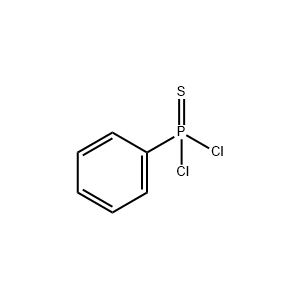 |
Key Applications
Organophosphorus Intermediate: Key reagent for preparing thiophosphonates and related derivatives through nucleophilic displacement of chloride.
Flame Retardant Precursor: Used in synthesis of sulfur-phosphorus containing additives for enhanced flame resistance in polymers and materials.
Specialty Polymer Synthesis: Incorporated into high-refractive-index or functional polymers requiring thiophosphoryl groups.
Chemical Research Building Block: Employed in laboratory-scale preparation of advanced organophosphorus compounds for catalysis and materials science.
Agrochemical and Fine Chemical Use: Applied in development of select phosphorus-based active ingredients and intermediates.
Safety and Storage
Phenylthiophosphonic dichloride is corrosive and moisture-sensitive, reacting with water to produce corrosive gases. Handle exclusively in a fume hood with full PPE, avoiding contact with water, alcohols, or bases. Store sealed under inert atmosphere in a cool, dry, ventilated area compatible with corrosive substances.
Aure Chemical: Your Reliable Partner
High Batch Consistency: Precise quality controls deliver uniform purity levels supported by detailed Certificate of Analysis.
Global Supply Reliability: Efficient logistics ensure stable delivery of bulk orders to international clients.
Full Regulatory Support: Comprehensive SDS, UN 3265 shipping documentation, and compliance materials provided.
Specialized Technical Help: Experienced team assists with safe handling, application advice, and custom packaging needs.
Hazards Classification
GHS Classification: Skin Corrosion Category 1B (GHS05), Serious Eye Damage Category 1 (GHS05), Corrosive to Metals, Acute Toxicity Category 4 (Oral).
Hazard Statements: H314 (Causes severe skin burns and eye damage), H290 (May be corrosive to metals), H302 (Harmful if swallowed).
UN Number: UN 3265
Hazard Class: 8 (Corrosive)
Packing Group: II

Packaging, Logistics & Compliance Capabilities
Aure Chemical provides flexible packaging solutions, compliant logistics arrangements, and controlled storage practices to support laboratory-scale, pilot-scale, and commercial-scale global supply.
Packaging Options
- 25 kg / 50 kg bags (fiber drum, aluminum bag, HDPE drum)
- 100 kg / 200 kg steel or HDPE drums
- 500 kg / 1000 kg IBC containers
- Bulk liquids in ISO tank containers
- Customized packaging upon request
Transportation Modes
- Sea freight (FCL / LCL)
- Air freight for selected products
- Road and rail transportation
- Dangerous & non-dangerous cargo handling
- Incoterms: EXW, FOB, CFR, CIF, DAP, DDP
Storage & Handling
- Dry, cool, and well-ventilated warehouses
- Segregation by hazard class
- FIFO inventory management
- Temperature-controlled storage if required
- Regular inspection & labeling control
Documentation & Compliance
- Safety Data Sheet (SDS)
- Certificate of Analysis (COA)
- Dangerous Goods Declaration (DGD)
- Packing List & Commercial Invoice
- IMDG / IATA / ADR compliant labeling
For packaging customization or logistics consultation, please contact us.